
Buying Guide
6 Best 55 Amp RV Converters in 2026: A Practical RV Guide
Six 55 amp RV converter chargers compared on true output, lead-acid vs lithium charging, fit in WF-9800 bays, and fan noise, with a pick for every budget.
By Hardcastle's RV Editors
11 min read6 products evaluated
A 55 amp converter is the workhorse size for most travel trailers and fifth wheels with a single 30 amp shore cord. It has to run every 12V load in the rig, from the water pump and vent fans to the furnace blower, while still putting meaningful current back into the house battery. When one fails, the lights dim, the fridge board drops out, and the battery slowly drains even while you are plugged in.
We compared six 55 amp units on what actually separates them: whether they hold full output when campground voltage sags, whether they charge lead-acid only or can switch to a 14.6V lithium profile, and whether they bolt into the same footprint as the WFCO WF-9800 deck-mount converter most RVs ship with. Prices run from about $62 to $249, and the cheapest unit is not automatically the wrong one.
Hardcastle’s RV field notes
The Rig Fit Check
A quick way to connect the shortlist to the space, workload and ownership details that matter after the box arrives.
- Start with the job
- WFCO WF-9855-AD-CB 55A Deck-Mount Converter Charger leads this shortlist for owners wanting an OEM-grade drop-in that is lithium ready. Use that fit as a reference point, then compare the alternatives against your own space and workload.
- Specs that separate the picks
- The first details to compare are 55A, auto lead-acid/LiFePO4, 55A regulated DC output, 55A, 4-stage charging. Confirm the exact model and included components before ordering.
- Trade-off to plan for
- Most expensive 55A unit here by a wide margin
The Practical Shortlist
A road-tested-thinking look at 6 options, organized around the job each one suits best.
Best Overall
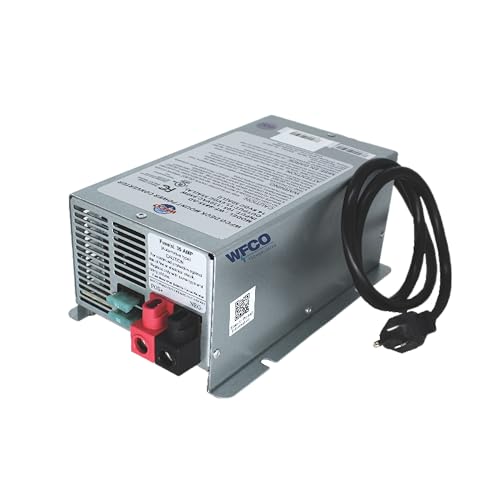
WFCO WF-9855-AD-CB 55A Deck-Mount Converter Charger
owners wanting an OEM-grade drop-in that is lithium ready
Our take Check price for WFCO WF-9855-AD-CB 55A Deck-Mount Converter Charger (opens in a new tab)

Runner-Up
PowerMax PM4-55A Deck-Mount Converter Charger, Lithium Compatible
DIY owners who want to set the charge voltage themselves
Our take Check price for PowerMax PM4-55A Deck-Mount Converter Charger, Lithium Compatible (opens in a new tab)

Best 4-Stage Charging
RecPro 55A RV Power Converter and Battery Charger
buyers comparing capacity, compatibility, included components and storage needs
Our take Check price for RecPro 55A RV Power Converter and Battery Charger (opens in a new tab)

Best Multi-Mode Value
WAVLINK GS800RV-55 55 Amp RV Power Converter
budget buyers planning a future lithium swap
Our take Check price for WAVLINK GS800RV-55 55 Amp RV Power Converter (opens in a new tab)

Best for Lead-Acid
SUPLIFE WF-9855 55 Amp Converter for Lead-Acid Batteries
lead-acid owners replacing a dead WF-9855
Our take Check price for SUPLIFE WF-9855 55 Amp Converter for Lead-Acid Batteries (opens in a new tab)

Best Budget
KSGNY WF-9855 55A RV Power Converter Charger
owners needing a cheap emergency replacement fast
Our take Check price for KSGNY WF-9855 55A RV Power Converter Charger (opens in a new tab)
Why Each Pick Made the Cut
Best Overall1 of 6
WFCO WF-9855-AD-CB 55A Deck-Mount Converter Charger on Amazon (opens in a new tab)
WFCO WF-9855-AD-CB 55A Deck-Mount Converter Charger makes the shortlist because auto-Detect picks lead-acid or LiFePO4 profile for you.
Best for
- owners wanting an OEM-grade drop-in that is lithium ready
Why it made the shortlist
This model is aimed at owners wanting an OEM-grade drop-in that is lithium ready. The documented setup centers on 55A, auto lead-acid/LiFePO4, full output down to 100V, uL/CSA listed.
The most useful documented advantage is auto-Detect picks lead-acid or LiFePO4 profile for you. Its Full output down to 100V specification sits at the upper end of the comparable range in this 3-product comparison. Treat the battery platform and included charger as part of the fit, not just the headline number.
The main limitation to plan around is most expensive 55A unit here by a wide margin. Confirm whether the battery and charger are included with the exact package. Check platform compatibility and published runtime against the area or workload you need to cover.
Key dimensions & specs
- 55A, auto lead-acid/LiFePO4
- Full output down to 100V
- UL/CSA listed
Pros
- Auto-Detect picks lead-acid or LiFePO4 profile for you
- Keeps full output when park voltage drops to 100V
- UL/CSA listed and FCC compliant
- Same deck-mount format most RVs ship with
Cons
- Most expensive 55A unit here by a wide margin
- No manual mode lock if auto-detect guesses wrong
Runner-Up2 of 6
PowerMax PM4-55A Deck-Mount Converter Charger, Lithium Compatible on Amazon (opens in a new tab)
The strongest case for PowerMax PM4-55A Deck-Mount Converter Charger, Lithium Compatible is about $106 cheaper than the WFCO pick.
Best for
- DIY owners who want to set the charge voltage themselves
Why it made the shortlist
For DIY owners who want to set the charge voltage themselves, this is one of the more relevant configurations in the shortlist. The documented setup centers on 55A regulated DC output, adjustable for lithium, standalone deck mount.
Its case starts with about $106 cheaper than the WFCO pick. Against the other 5 picks, the useful comparison starts with 55A regulated DC output and adjustable for lithium. Those details show whether its configuration suits the job better than a neighboring recommendation.
The trade-off worth checking first is no auto battery detection. Confirm the exact model number and included components before ordering. Check dimensions, compatibility and maintenance needs against the way you plan to use and store it.
Key dimensions & specs
- 55A regulated DC output
- Adjustable for lithium
- Standalone deck mount
Pros
- About $106 cheaper than the WFCO pick
- Adjustable output can match a lithium charge voltage
- Reverse-polarity and thermal protection built in
Cons
- No auto battery detection
- Setup takes more reading than a switch
Best 4-Stage Charging3 of 6
RecPro 55A RV Power Converter and Battery Charger on Amazon (opens in a new tab)
RecPro 55A RV Power Converter and Battery Charger is the better fit when buyers comparing capacity, compatibility, included components and storage needs.
Best for
- buyers comparing capacity, compatibility, included components and storage needs
Why it made the shortlist
The intended use case is buyers comparing capacity, compatibility, included components and storage needs. The documented setup centers on 55A, 4-stage charging, lead and lithium compatible, also sold 35A to 100A.
What separates it on paper is 4-stage charging adds a storage stage for long parking. Against the other 5 picks, the useful comparison starts with 55A, 4-stage charging and lead and lithium compatible. Those details show whether its configuration suits the job better than a neighboring recommendation.
Before committing, account for listing gives few technical details. Confirm the exact model number and included components before ordering. Check dimensions, compatibility and maintenance needs against the way you plan to use and store it.
Key dimensions & specs
- 55A, 4-stage charging
- Lead and lithium compatible
- Also sold 35A to 100A
Pros
- 4-stage charging adds a storage stage for long parking
- Sold in six amp sizes from one RV brand
- Charges the battery while running 12V lights
Cons
- Listing gives few technical details
- Lithium mode selection not explained
Best Multi-Mode Value4 of 6
WAVLINK GS800RV-55 55 Amp RV Power Converter on Amazon (opens in a new tab)
Choose WAVLINK GS800RV-55 55 Amp RV Power Converter for separate lead-acid and lithium charging modes.
Best for
- budget buyers planning a future lithium swap
Why it made the shortlist
WAVLINK GS800RV-55 55 Amp RV Power Converter is positioned for budget buyers planning a future lithium swap. The documented setup centers on lead-acid, lithium, fixed modes, 13.0V to 16.5V fixed range, temp-controlled fan.
The feature doing most of the work here is separate lead-acid and lithium charging modes. Its 13.0V to 16.5V fixed range specification sits at the lower end of the comparable range in this 3-product comparison. Treat the battery platform and included charger as part of the fit, not just the headline number.
The practical constraint here is 16.5V setting can overcharge a 12V battery if misused. Confirm whether the battery and charger are included with the exact package. Check platform compatibility and published runtime against the area or workload you need to cover.
Key dimensions & specs
- Lead-acid, lithium, fixed modes
- 13.0V to 16.5V fixed range
- Temp-controlled fan
Pros
- Separate lead-acid and lithium charging modes
- Fixed voltage mode adjusts from 13.0V to 16.5V
- Fan only spins up when the unit gets warm
- Metal housing helps shed heat
Cons
- 16.5V setting can overcharge a 12V battery if misused
- No UL listing mentioned
Best for Lead-Acid5 of 6
SUPLIFE WF-9855 55 Amp Converter for Lead-Acid Batteries on Amazon (opens in a new tab)
SUPLIFE WF-9855 55 Amp Converter for Lead-Acid Batteries makes the shortlist because fits WF-9855 and other WF-9800 series bays.
Best for
- lead-acid owners replacing a dead WF-9855
Why it made the shortlist
This model is aimed at lead-acid owners replacing a dead WF-9855. The documented setup centers on 950W, 55A output, lead-acid only, 3-stage, 5-year warranty.
The most useful documented advantage is fits WF-9855 and other WF-9800 series bays. Against the other 5 picks, the useful comparison starts with 950W, 55A output and lead-acid only, 3-stage. Those details show whether its configuration suits the job better than a neighboring recommendation.
The main limitation to plan around is no lithium charging profile. Confirm the exact model number and included components before ordering. Check dimensions, compatibility and maintenance needs against the way you plan to use and store it.
Key dimensions & specs
- 950W, 55A output
- Lead-acid only, 3-stage
- 5-year warranty
Pros
- Fits WF-9855 and other WF-9800 series bays
- 5-year warranty beyond the Amazon return window
- Copper fan rated about 30 percent quieter
Cons
- No lithium charging profile
- Clone brand without UL listing documented
Best Budget6 of 6
KSGNY WF-9855 55A RV Power Converter Charger on Amazon (opens in a new tab)
The strongest case for KSGNY WF-9855 55A RV Power Converter Charger is mounting brackets and terminals included.
Best for
- owners needing a cheap emergency replacement fast
Why it made the shortlist
For owners needing a cheap emergency replacement fast, this is one of the more relevant configurations in the shortlist. The documented setup centers on 950W, 13.6V output, 105 to 130VAC input, fan rated under 30dB.
Its case starts with mounting brackets and terminals included. Its 950W, 13.6V output specification sits at between the lower and upper ends of the comparable range in this 3-product comparison. Treat the battery platform and included charger as part of the fit, not just the headline number.
The trade-off worth checking first is fixed 13.6V output charges batteries slowly. Confirm whether the battery and charger are included with the exact package. Check platform compatibility and published runtime against the area or workload you need to cover.
Key dimensions & specs
- 950W, 13.6V output
- 105 to 130VAC input
- Fan rated under 30dB
Pros
- Mounting brackets and terminals included
- 5-year replacement warranty
- Fan rated under 30dB for quiet nights
Cons
- Fixed 13.6V output charges batteries slowly
- Not suited as a lithium charger
How We Built This Shortlist
Each pick was assessed across 5 criteria weighted for real-world use.
- Output under weak shore power
- We looked for documented behavior when pedestal voltage drops toward 105V or lower, since low campground voltage is the most common real-world stress on a converter.
- Charging profile and chemistry support
- Each unit was sorted by whether it offers lead-acid only, a manual lithium mode, or automatic detection, and what charge voltages it actually publishes.
- Fit in the existing WF-9800 bay
- We compared stated compatibility with WF-9855 series deck-mount bays so a replacement can reuse existing mounting and wiring.
- Protection and certification
- We checked for current limiting, reverse polarity, thermal shutdown, and any UL or CSA listing, weighting documented certification above marketing claims.
- Warranty and real cost
- Price was weighed against warranty length and how much you would need to add, such as a separate charger, to make the unit fully useful.
What Matters Before You Choose a 55 Amp RV Converter
Key buying criteria so you get the right fit the first time.
Continuous 55 amp output
The amp rating is the total DC current the converter can supply to your 12V loads and battery combined. If the furnace blower, pump, and lights already draw 20 to 25 amps, only the remaining current goes into charging, so an undersized or derated unit charges painfully slowly. Confirm the listing states 55 amps continuous at around 950 watts rather than a peak figure.
Charging profile, not just voltage
A converter that only puts out a flat 13.6V is acting as a power supply, and it can take a day or more to refill a lead-acid battery. A true multi-stage charger raises voltage for bulk charging, then drops to float or storage so the battery is not cooked during weeks on shore power. Look for named stages such as bulk, absorption, and float in the bullet points, not just one output voltage.
Lithium compatibility you can verify
A 12V LiFePO4 battery wants roughly 14.2 to 14.6V to fill and no constant high float, which a lead-acid profile does not provide. Running lithium on a lead-only converter usually leaves the bank undercharged rather than dangerous, but you lose much of the capacity you paid for. Check for a stated lithium mode or Auto-Detect and the exact lithium voltage, which should be 14.6V or a little below.
Low input voltage tolerance
Campground pedestals often sag toward 105V or lower on hot days when every rig runs air conditioning. Some converters cut output when input drops, which slows charging exactly when you need it. Look for a published minimum input voltage at full output; only the WFCO here documents full power down to 100V.
Physical fit and mounting style
Most trailers use a deck-mount WF-9800 series unit, often under the fridge or near the panel. A replacement that matches the footprint reuses the screws and DC lugs, while a mismatched unit means new holes and cable runs. Measure your existing converter and compare it to the listed dimensions and model compatibility before ordering.
Fan noise and certification
The converter often sits under a bed or dinette, so a fan that runs constantly can keep light sleepers awake. Temperature or load controlled fans stay quiet at low draw, and UL or CSA listing shows the unit passed third-party safety review. Look for a variable-speed fan description and an explicit listing mark rather than vague quality claims.
Match a 55 Amp RV Converter to Your RV
By Battery Chemistry
| Your battery | Recommended pick | Why |
|---|---|---|
| Flooded or AGM, no plans to change | SUPLIFE WF-9855 | Three-stage lead-acid charging and a 5-year warranty |
| Lead-acid now, lithium within a year | WFCO WF-9855-AD-CB | Auto-Detect switches profile when you swap the battery |
| LiFePO4 already installed | WAVLINK GS800RV-55 | Dedicated lithium mode at a sub-$100 price |
| Custom lithium voltage from the battery maker | PowerMax PM4-55A | Adjustable output lets you match the spec |
| Unsure, just need power tonight | KSGNY WF-9855 | Cheapest way to restore 12V loads |
Scroll sideways to see every column.
By Budget
| Budget | Recommended pick |
|---|---|
| Under $70 | KSGNY WF-9855 |
| $70 to $100 | WAVLINK GS800RV-55 or SUPLIFE WF-9855 |
| $140 to $150 | PowerMax PM4-55A or RecPro 55A |
| Around $250 | WFCO WF-9855-AD-CB |
Auto-Detect vs Manual Mode
- Auto-Detect
- The converter reads battery behavior and chooses lead-acid or lithium charging on its own, so there is nothing to remember after a battery swap. In this comparison that is the WFCO WF-9855-AD-CB.
- Manual or adjustable mode
- You select the profile with a switch or set the output yourself, which removes any chance of a wrong guess but depends on you getting it right. That covers the WAVLINK GS800RV-55 and the PowerMax PM4-55A.
Most owners who swap batteries rarely should default to the WFCO; tinkerers who want certainty should go manual.
By Campground Power Quality
| Where you camp | Recommended pick |
|---|---|
| Older parks with sagging pedestals | WFCO WF-9855-AD-CB |
| Mostly full-hookup resorts | RecPro 55A |
| Driveway or seasonal site on a stable home circuit | PowerMax PM4-55A |
| Mostly generator power | WAVLINK GS800RV-55 |
For Replacing a Factory WF-9855 Specifically
- Look for
- An explicit WF-9855 or WF-9800 series fit claim, so the deck-mount footprint, screw holes, and DC lugs line up with what is already in the bay.
- In this comparison
- The WFCO WF-9855-AD-CB is the genuine replacement, while the SUPLIFE WF-9855 and KSGNY WF-9855 are clones that list WF-9800 series compatibility at a fraction of the price.
When to Spend More
- Spend more if
- You camp at busy parks with weak power or plan a lithium upgrade; the WFCO WF-9855-AD-CB holds output to 100V and switches profiles automatically.
- Save if
- You run lead-acid at stable full-hookup sites; the SUPLIFE WF-9855 covers the job for under $80 with a longer warranty than most.
Before You Bring One Home
Will a 55 amp converter fit where my WF-9855 was?
Most WF-9800 series replacements are designed to match the WF-9855 deck-mount footprint and wiring. The WFCO WF-9855-AD-CB is the genuine part, and the SUPLIFE and KSGNY units list WF-9800 series fit. Measure the old unit before ordering a standalone like the PowerMax, which may need new mounting holes.
What is the most common mistake when replacing a converter?
Buying a lead-acid only unit and then installing lithium batteries. The battery will usually stay undercharged at around 13.6V, so you lose usable capacity and the state-of-charge readings look wrong. If lithium is anywhere in your plans, pick a unit with a lithium mode or Auto-Detect.
Is the WFCO worth it over a $60 clone?
For many owners yes, because it documents full output down to 100V input, carries UL/CSA listing, and switches lithium profiles automatically. If you camp only at stable full-hookup sites with lead-acid batteries, a clone such as the SUPLIFE does the core job for far less.
How do I install a replacement converter safely?
Unplug shore power, turn off any inverter, and disconnect the battery negative before touching the converter. Photograph the wiring, move each DC lead to the same terminal on the new unit, and torque the lugs firmly. Reconnect the battery first, then shore power, and confirm voltage at the battery rises.
Is 55 amps enough for my RV?
A 55 amp unit suits most single-axle and tandem trailers with one or two batteries on a 30 amp service. If you have a large lithium bank and want fast recharge from a generator, a 60 to 100 amp converter cuts charge time noticeably.
Why does my converter fan run all the time?
A fan that never stops usually means the unit is working near its limit or sits in a hot, poorly vented space. Check that the vents are clear and that loads are not near 55 amps. Units like the WAVLINK only start the fan when temperature rises, so constant running is a sign to investigate.
Bottom Line
Best overall: WFCO WF-9855-AD-CB 55A Deck-Mount Converter Charger — best overall pick in this roundup. See the full verdicts above for every pick, with pros, cons and who each one suits.
Browse all 55 amp rv converters on Amazon — Prime-eligible options with current pricing.