
Buying Guide
4 Best Lithium RV Battery Monitor in 2026: A Practical RV Guide
Four lithium-ready RV battery monitors compared by measurement method, shunt rating, alerts and price, so you can match one to your LiFePO4 bank.
By Hardcastle's RV Editors
10 min read4 products evaluated
A lithium battery hides its state of charge. Voltage barely moves between 90 percent and 30 percent on LiFePO4, so a plain voltmeter tells you almost nothing until the pack is nearly empty. That is why the measurement method matters more than the display on a lithium RV monitor. We compared four options by how they measure, how much current they handle, and what they cost, and we flag where a listing stays silent on lithium behavior.
Hardcastle’s RV field notes
The Rig Fit Check
A quick way to connect the shortlist to the space, workload and ownership details that matter after the box arrives.
- Start with the job
- BINTA Shunt Battery Monitor 8-120V 0-150A Voltage Current Voltmeter Ammeter leads this shortlist for A 100Ah to 300Ah LiFePO4 bank with a modest inverter. Use that fit as a reference point, then compare the alternatives against your own space and workload.
- Specs that separate the picks
- The first details to compare are Shunt, 100A continuous, 150A peak, Bluetooth, 6V/12V/24V, Bluetooth 5.3, 72 days history. Confirm the exact model and included components before ordering.
- Trade-off to plan for
- 100A continuous limit is tight for large inverters
The Practical Shortlist
A road-tested-thinking look at 4 options, organized around the job each one suits best.

Best Overall
BINTA Shunt Battery Monitor 8-120V 0-150A Voltage Current Voltmeter Ammeter
A 100Ah to 300Ah LiFePO4 bank with a modest inverter
Our take Check price for BINTA Shunt Battery Monitor 8-120V 0-150A Voltage Current Voltmeter Ammeter (opens in a new tab)

Runner-Up
24V 12V 6V Bluetooth Battery Monitor BM7-Work for All Lead-Acid & Lithium Battery with Charging
A simple health check on a single house battery
Our take Check price for 24V 12V 6V Bluetooth Battery Monitor BM7-Work for All Lead-Acid & Lithium Battery with Charging (opens in a new tab)
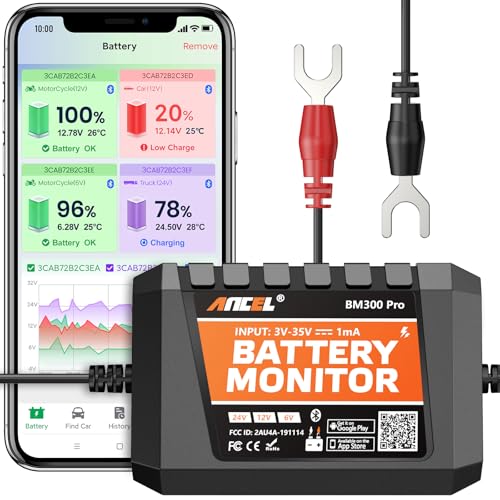
Best for Multiple Batteries
ANCEL BM300 Pro Bluetooth Battery Monitor for 6V
Owners watching a chassis battery plus a house bank
Our take Check price for ANCEL BM300 Pro Bluetooth Battery Monitor for 6V (opens in a new tab)

Best Budget
DROK 48v Golf Cart Battery Meter - LCD Display Lithium Battery Monitor 10-100v Volt Meter Temperature Gauge fo
A cheap voltage readout on a small or secondary bank
Our take Check price for DROK 48v Golf Cart Battery Meter - LCD Display Lithium Battery Monitor 10-100v Volt Meter Temperature Gauge fo (opens in a new tab)
Why Each Pick Made the Cut
Best Overall1 of 4
BINTA Shunt Battery Monitor 8-120V 0-150A Voltage Current Voltmeter Ammeter on Amazon (opens in a new tab)
Choose BINTA Shunt Battery Monitor 8-120V 0-150A Voltage Current Voltmeter Ammeter for counts real amps, so lithium percentage stays meaningful.
Best for
- A 100Ah to 300Ah LiFePO4 bank with a modest inverter
Why it made the shortlist
BINTA Shunt Battery Monitor 8-120V 0-150A Voltage Current Voltmeter Ammeter is positioned for A 100Ah to 300Ah LiFePO4 bank with a modest inverter. The documented setup centers on shunt, 100A continuous, 150A peak, 8-120V, LiFePO4 listed, up to 999Ah capacity.
The feature doing most of the work here is counts real amps, so lithium percentage stays meaningful. Its 8-120V, LiFePO4 listed specification sits at the upper end of the comparable range in this 3-product comparison. Treat the battery platform and included charger as part of the fit, not just the headline number.
The practical constraint here is 100A continuous limit is tight for large inverters. Confirm whether the battery and charger are included with the exact package. Check platform compatibility and published runtime against the area or workload you need to cover.
Key dimensions & specs
- Shunt, 100A continuous, 150A peak
- 8-120V, LiFePO4 listed
- Up to 999Ah capacity
Pros
- Counts real amps, so lithium percentage stays meaningful
- Backlit display readable in direct sunlight
- Remembers saved settings even after a full power loss
Cons
- 100A continuous limit is tight for large inverters
- Wired display needs a cable run and mounting
Runner-Up2 of 4
24V 12V 6V Bluetooth Battery Monitor BM7-Work for All Lead-Acid & Lithium Battery with Charging on Amazon (opens in a new tab)
24V 12V 6V Bluetooth Battery Monitor BM7-Work for All Lead-Acid & Lithium Battery with Charging makes the shortlist because installs on the terminals with no shunt wiring.
Best for
- A simple health check on a single house battery
Why it made the shortlist
This model is aimed at A simple health check on a single house battery. The documented setup centers on bluetooth, 6V/12V/24V, iP67, reverse-polarity protected, liFePO4 listed as supported.
The most useful documented advantage is installs on the terminals with no shunt wiring. Its Bluetooth, 6V/12V/24V specification sits at the lower end of the comparable range in this 3-product comparison. Treat the battery platform and included charger as part of the fit, not just the headline number.
The main limitation to plan around is no amp counting listed, so percentage is an estimate. Confirm whether the battery and charger are included with the exact package. Check platform compatibility and published runtime against the area or workload you need to cover.
Key dimensions & specs
- Bluetooth, 6V/12V/24V
- IP67, reverse-polarity protected
- LiFePO4 listed as supported
Pros
- Installs on the terminals with no shunt wiring
- Phone app shows voltage and temperature remotely
- IP67 housing suits an exposed battery bay
Cons
- No amp counting listed, so percentage is an estimate
- Needs the phone nearby for live data
Best for Multiple Batteries3 of 4
ANCEL BM300 Pro Bluetooth Battery Monitor for 6V on Amazon (opens in a new tab)
The strongest case for ANCEL BM300 Pro Bluetooth Battery Monitor for 6V is one app covers up to four separate batteries.
Best for
- Owners watching a chassis battery plus a house bank
Why it made the shortlist
For Owners watching a chassis battery plus a house bank, this is one of the more relevant configurations in the shortlist. The documented setup centers on bluetooth 5.3, 72 days history, pairs four units per app, about 1mA draw, IP67.
Its case starts with one app covers up to four separate batteries. Against the other 3 picks, the useful comparison starts with bluetooth 5.3, 72 days history and pairs four units per app. Those details show whether its configuration suits the job better than a neighboring recommendation.
The trade-off worth checking first is lithium support is not stated in the listing. Confirm the exact model number and included components before ordering. Check dimensions, compatibility and maintenance needs against the way you plan to use and store it.
Key dimensions & specs
- Bluetooth 5.3, 72 days history
- Pairs four units per app
- About 1mA draw, IP67
Pros
- One app covers up to four separate batteries
- 72 days of stored history syncs later
- About 1mA draw will not drain a parked bank
Cons
- Lithium support is not stated in the listing
- Estimates charge from voltage, no shunt
Best Budget4 of 4
DROK 48v Golf Cart Battery Meter - LCD Display Lithium Battery Monitor 10-100v Volt Meter Temperature Gauge fo on Amazon (opens in a new tab)
DROK 48v Golf Cart Battery Meter - LCD Display Lithium Battery Monitor 10-100v Volt Meter Temperature Gauge fo is the better fit when a cheap voltage readout on a small or secondary bank.
Best for
- A cheap voltage readout on a small or secondary bank
Why it made the shortlist
The intended use case is A cheap voltage readout on a small or secondary bank. The documented setup centers on 10-100V, LiFePO4 listed, programmable voltage-to-percent, temperature in Fahrenheit.
What separates it on paper is cheapest way to see live pack voltage. Its 10-100V, LiFePO4 listed specification sits at between the lower and upper ends of the comparable range in this 3-product comparison. Treat the battery platform and included charger as part of the fit, not just the headline number.
Before committing, account for defaults to a 48V lead-acid profile. Confirm whether the battery and charger are included with the exact package. Check platform compatibility and published runtime against the area or workload you need to cover.
Key dimensions & specs
- 10-100V, LiFePO4 listed
- Programmable voltage-to-percent
- Temperature in Fahrenheit
Pros
- Cheapest way to see live pack voltage
- Wide 10-100V range suits 12V to 48V
- Percentage points can be set by hand
Cons
- Defaults to a 48V lead-acid profile
- Temperature is the meter body, not the cells
How We Built This Shortlist
Each pick was assessed across 4 criteria weighted for real-world use.
- Measurement method
- We separated shunt current counting from voltage-based estimates, since that decides whether a lithium percentage can be trusted.
- Lithium support stated
- We checked whether the listing names LiFePO4 or lithium, and marked silence as unverified instead of assuming support.
- Current and voltage range
- We compared continuous amps, peak amps and system voltage against typical RV inverter and bank sizes.
- Display and alerts
- We weighed wired displays, app access, stored history and idle draw against what an owner reads daily.
What Matters Before You Choose a Lithium RV Battery Monitor
Key buying criteria so you get the right fit the first time.
Shunt versus voltage readout
A shunt measures current on the negative cable and integrates it into amp-hours, while a voltage monitor guesses from volts. LiFePO4 holds near 13.2 to 13.3V across most of its range, so a voltage guess can be off by tens of percent. Look for the words shunt, amp-hours or coulomb counting on the listing.
Lithium named in the listing
Chemistry settings change how a monitor reads charge and when it calls the pack full. A monitor tuned for lead-acid will mislabel a resting LiFePO4 bank as nearly empty or full. Check that LiFePO4 or lithium appears in the supported battery types, not just a generic 12V claim.
Continuous and peak amps
The shunt carries your entire load, so its rating caps what you can safely run through it. A 100A continuous shunt will overheat behind a 2000W inverter, which can pull over 170A at 12V. Compare the continuous figure on the listing with your inverter wattage divided by 12.
Idle draw and sleep mode
A monitor runs all the time, including while the rig is parked for months. A draw of about 1mA, as the ANCEL BM300 lists, costs under 1Ah a month, while a backlit display can pull far more. Look for a stated idle or sleep current in milliamps.
Alerts, logging and display
A screen on the wall is easy to read but only helps when you are inside, while an app can warn you from the campsite. History matters when you want to see why a bank dropped overnight. Check whether the listing names stored history length and whether alerts need the phone in Bluetooth range.
Match a Lithium RV Battery Monitor to Your RV
By Measurement Method
| Your situation | Recommended pick | Why |
|---|---|---|
| You size trips by remaining percentage | BINTA Shunt | It counts amp-hours, so the number stays valid while the pack sits in the flat LiFePO4 voltage curve. |
| You want a quick health check from your phone | Quicklynks BM7 | It clips on, lists LiFePO4, and reports voltage and temperature without any shunt wiring. |
| You monitor a chassis battery and a house bank | ANCEL BM300 | One app shows up to four batteries, each with its own unit and stored history. |
| You only need to see live pack voltage | DROK Meter | It is a $17.49 voltage meter with a hand-programmed percentage table. |
Scroll sideways to see every column.
By Budget
| Budget | Recommended pick |
|---|---|
| $10 to $40 | DROK Meter or BINTA Shunt |
| $30 to $50 | Quicklynks BM7 or ANCEL BM300 |
Shunt vs Voltage-Based
- Shunt (current counting)
- A shunt sits on the negative cable and measures every amp, so state of charge survives LiFePO4's flat voltage curve. In this roundup that is the BINTA Shunt, limited to 100A continuous.
- Voltage-based (clip-on or panel)
- These infer charge from resting voltage, which is fine for lead-acid but loose for lithium mid-range. The Quicklynks BM7, ANCEL BM300 and DROK Meter all work this way.
Most lithium owners should default to the BINTA Shunt unless a wireless install matters more than percentage accuracy.
By Install Style
| Best match | Recommended pick |
|---|---|
| Wired display near the bed or galley | BINTA Shunt |
| No cable runs, battery bay only | Quicklynks BM7 |
| Several batteries across rig and tow vehicle | ANCEL BM300 |
| Panel mount in a golf cart or small bank | DROK Meter |
For a LiFePO4 House Bank Specifically
- Look for
- A shunt rated above your inverter's maximum DC draw, plus LiFePO4 named on the listing.
- In this comparison
- The BINTA Shunt matches both for banks under 100A continuous; the Quicklynks BM7 names LiFePO4 but estimates charge instead of counting amps.
When to Spend More
- Spend more if
- Spend more if your inverter can pull past 100A, since the BINTA Shunt tops out there and a pricier shunt avoids a failure under load.
- Save if
- Save if you only want a quick glance at voltage, where the DROK Meter at $17.49 does the job.
Before You Bring One Home
Can a voltage-only monitor work with lithium?
It can show pack voltage, but its percentage will be loose because LiFePO4 voltage stays flat for most of the discharge. Use it as a health check and add a shunt if you plan around remaining capacity.
Does a lithium battery's own BMS replace a monitor?
The BMS protects the cells and often reports basic data, but it only cuts off at limits and does not always track your daily use. A separate monitor shows the trend before the BMS steps in.
What current rating should the shunt have?
Divide your inverter wattage by 12 and add headroom, so a 1000W inverter needs at least 84A before losses. The BINTA Shunt lists 100A continuous, which fits that size but not a 2000W unit.
Where does the shunt go?
It goes on the negative cable between the battery and every load and charger, with all ground paths running through it. A load wired around the shunt is not counted, which skews the percentage.
Do these monitors need calibration?
A shunt monitor needs your battery capacity and a full-charge sync point entered once, and it may drift without a periodic full charge. Voltage monitors need little setup but never become accurate.
Bottom Line
Best overall: BINTA Shunt Battery Monitor 8-120V 0-150A Voltage Current Voltmeter Ammeter — best overall pick in this roundup. See the full verdicts above for every pick, with pros, cons and who each one suits.
Browse all lithium rv battery monitor on Amazon — Prime-eligible options with current pricing.