
Buying Guide
5 Best RV Inverters With Transfer Switch in 2026: A Practical RV Guide
RV inverters with a built-in automatic transfer switch, compared on switch time, pass-through rating, hardwire input, and output, from 1500W to 3000W.
By Hardcastle's RV Editors
10 min read5 products evaluated
An inverter with a built-in transfer switch lets your RV outlets pass shore power straight through when you are plugged in, then flip to battery power the moment the pedestal or generator drops. Without one, you either rewire outlets by hand or add a separate transfer switch box. The important details are often buried: how fast the switch moves loads, how many amps it can pass through, and whether there is a hardwired AC input terminal for an RV panel.
The pool of true transfer-switch inverters is smaller than the general inverter market, so this list has five picks rather than seven. Each one has a documented automatic transfer switch, and we compared switch speed, wiring options, and output from a 1500W budget unit to a 3000W model with app monitoring.
Hardcastle’s RV field notes
The Rig Fit Check
A quick way to connect the shortlist to the space, workload and ownership details that matter after the box arrives.
- Start with the job
- Renogy PUH 3000W Pure Sine Inverter with UPS Transfer Switch, Bluetooth leads this shortlist for adding 3000W AC to an RV with a good converter. Use that fit as a reference point, then compare the alternatives against your own space and workload.
- Specs that separate the picks
- The first details to compare are 3000W pure sine, >92% efficient, 2000W, 6000W surge for 20 sec, 2000W / 4000W peak. Confirm the exact model and included components before ordering.
- Trade-off to plan for
- No battery charger built in
The Practical Shortlist
A road-tested-thinking look at 5 options, organized around the job each one suits best.

Best Overall
Renogy PUH 3000W Pure Sine Inverter with UPS Transfer Switch, Bluetooth
adding 3000W AC to an RV with a good converter
Our take Check price for Renogy PUH 3000W Pure Sine Inverter with UPS Transfer Switch, Bluetooth (opens in a new tab)
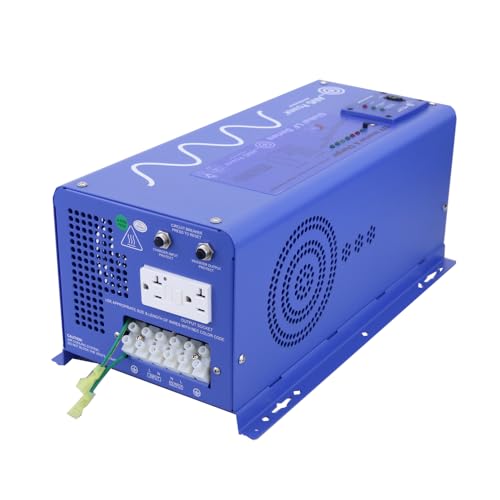
Best 3-in-1
AIMS 2000W 12V Pure Sine Inverter Charger with Transfer Switch
replacing a converter with one integrated system
Our take Check price for AIMS 2000W 12V Pure Sine Inverter Charger with Transfer Switch (opens in a new tab)

Best Value
LiTime 12V 2000W Inverter with ATS Transfer Switch
budget-conscious owners wanting a trusted brand
Our take Check price for LiTime 12V 2000W Inverter with ATS Transfer Switch (opens in a new tab)

Best for Panel Wiring
2500W Pure Sine Inverter with Built-in ATS for RVs
wiring a dedicated inverter subpanel
Our take Check price for 2500W Pure Sine Inverter with Built-in ATS for RVs (opens in a new tab)

Best Budget
1500W Pure Sine Inverter with 12ms Transfer Switch, LCD Remote
small trailers powering a few outlets
Our take Check price for 1500W Pure Sine Inverter with 12ms Transfer Switch, LCD Remote (opens in a new tab)
Why Each Pick Made the Cut
Best Overall1 of 5
Renogy PUH 3000W Pure Sine Inverter with UPS Transfer Switch, Bluetooth on Amazon (opens in a new tab)
Choose Renogy PUH 3000W Pure Sine Inverter with UPS Transfer Switch, Bluetooth for 3000W runs microwaves and coffee makers together.
Best for
- adding 3000W AC to an RV with a good converter
Why it made the shortlist
Renogy PUH 3000W Pure Sine Inverter with UPS Transfer Switch, Bluetooth is positioned for adding 3000W AC to an RV with a good converter. The documented setup centers on 3000W pure sine, >92% efficient, built-in UPS transfer switch, bluetooth app and wired remote.
The feature doing most of the work here is 3000W runs microwaves and coffee makers together. Against the other 4 picks, the useful comparison starts with 3000W pure sine, >92% efficient and built-in UPS transfer switch. Those details show whether its configuration suits the job better than a neighboring recommendation.
The practical constraint here is no battery charger built in. Confirm the exact model number and included components before ordering. Check dimensions, compatibility and maintenance needs against the way you plan to use and store it.
Key dimensions & specs
- 3000W pure sine, >92% efficient
- Built-in UPS transfer switch
- Bluetooth app and wired remote
Pros
- 3000W runs microwaves and coffee makers together
- Idle draw under 18W protects battery capacity
- Bluetooth app and wired remote included
- Cooling fans stay quiet, under 51dB
Cons
- No battery charger built in
Best 3-in-12 of 5
AIMS 2000W 12V Pure Sine Inverter Charger with Transfer Switch on Amazon (opens in a new tab)
AIMS 2000W 12V Pure Sine Inverter Charger with Transfer Switch makes the shortlist because inverter, charger, and transfer switch in one unit.
Best for
- replacing a converter with one integrated system
Why it made the shortlist
This model is aimed at replacing a converter with one integrated system. The documented setup centers on 2000W, 6000W surge for 20 sec, 70A charger with LiFePO4 mode, built-in transfer switch.
The most useful documented advantage is inverter, charger, and transfer switch in one unit. Against the other 4 picks, the useful comparison starts with 2000W, 6000W surge for 20 sec and 70A charger with LiFePO4 mode. Those details show whether its configuration suits the job better than a neighboring recommendation.
The main limitation to plan around is heavy low-frequency transformer design. Confirm the exact model number and included components before ordering. Check dimensions, compatibility and maintenance needs against the way you plan to use and store it.
Key dimensions & specs
- 2000W, 6000W surge for 20 sec
- 70A charger with LiFePO4 mode
- Built-in transfer switch
Pros
- Inverter, charger, and transfer switch in one unit
- 6000W surge for 20 seconds starts motors
- Lithium wake-up revives over-discharged batteries
Cons
- Heavy low-frequency transformer design
Best Value3 of 5
LiTime 12V 2000W Inverter with ATS Transfer Switch on Amazon (opens in a new tab)
The strongest case for LiTime 12V 2000W Inverter with ATS Transfer Switch is clear 20ms switch time in the spec.
Best for
- budget-conscious owners wanting a trusted brand
Why it made the shortlist
For budget-conscious owners wanting a trusted brand, this is one of the more relevant configurations in the shortlist. The documented setup centers on 2000W / 4000W peak, 20ms ATS with utility bypass, rated minus 20C to 40C.
Its case starts with clear 20ms switch time in the spec. Against the other 4 picks, the useful comparison starts with 2000W / 4000W peak and 20ms ATS with utility bypass. Those details show whether its configuration suits the job better than a neighboring recommendation.
The trade-off worth checking first is 2000W limits combined loads. Confirm the exact model number and included components before ordering. Check dimensions, compatibility and maintenance needs against the way you plan to use and store it.
Key dimensions & specs
- 2000W / 4000W peak
- 20ms ATS with utility bypass
- Rated minus 20C to 40C
Pros
- Clear 20ms switch time in the spec
- Battery cables and mounting hardware included
- Rated to work down to minus 20C
Cons
- 2000W limits combined loads
- No app monitoring
Best for Panel Wiring4 of 5
2500W Pure Sine Inverter with Built-in ATS for RVs on Amazon (opens in a new tab)
2500W Pure Sine Inverter with Built-in ATS for RVs is the better fit when wiring a dedicated inverter subpanel.
Best for
- wiring a dedicated inverter subpanel
Why it made the shortlist
The intended use case is wiring a dedicated inverter subpanel. The documented setup centers on 2500W / 5000W peak, hardwired 3-wire AC input, built-in ATS.
What separates it on paper is hardwired input terminal suits RV breaker panels. Against the other 4 picks, the useful comparison starts with 2500W / 5000W peak and hardwired 3-wire AC input. Those details show whether its configuration suits the job better than a neighboring recommendation.
Before committing, account for transfer switch time not stated. Confirm the exact model number and included components before ordering. Check dimensions, compatibility and maintenance needs against the way you plan to use and store it.
Key dimensions & specs
- 2500W / 5000W peak
- Hardwired 3-wire AC input
- Built-in ATS
Pros
- Hardwired input terminal suits RV breaker panels
- Supports lithium and lead-acid batteries
Cons
- Transfer switch time not stated
- Only 12 months of support
Best Budget5 of 5
1500W Pure Sine Inverter with 12ms Transfer Switch, LCD Remote on Amazon (opens in a new tab)
Choose 1500W Pure Sine Inverter with 12ms Transfer Switch, LCD Remote for 12ms switch is the fastest quoted here.
Best for
- small trailers powering a few outlets
Why it made the shortlist
1500W Pure Sine Inverter with 12ms Transfer Switch, LCD Remote is positioned for small trailers powering a few outlets. The documented setup centers on 1500W / 3000W peak, 12ms automatic transfer, 15 ft LCD remote.
The feature doing most of the work here is 12ms switch is the fastest quoted here. Against the other 4 picks, the useful comparison starts with 1500W / 3000W peak and 12ms automatic transfer. Those details show whether its configuration suits the job better than a neighboring recommendation.
The practical constraint here is 1500W cannot run a microwave. Measure the actual run from the hookup or outlet to where the gear will sit before choosing this length, and leave slack for uneven sites.
Key dimensions & specs
- 1500W / 3000W peak
- 12ms automatic transfer
- 15 ft LCD remote
Pros
- 12ms switch is the fastest quoted here
- LCD remote shows faults from inside the RV
- Battery cables included in the box
Cons
- 1500W cannot run a microwave
- Lesser-known brand
How We Built This Shortlist
Each pick was assessed across 5 criteria weighted for real-world use.
- Documented Transfer Switch
- Included only inverters whose listing describes a built-in automatic transfer switch, not a manual bypass.
- Switch Time and Rating
- Compared quoted switch times and noted where transfer current ratings were missing.
- Wiring Options
- Checked for hardwired AC input terminals suited to RV panels versus outlet-only designs.
- Output and Surge
- Compared continuous and surge output against common RV loads like microwaves and coffee makers.
- Extras and Support
- Weighed remote panels, apps, included cables, chargers, and support terms.
What Matters Before You Choose an RV Inverter With Transfer Switch
Key buying criteria so you get the right fit the first time.
Automatic, Not Manual Switching
An automatic transfer switch senses shore power and moves loads between shore and battery without you touching anything. Some inverters only offer a bypass or require plugging appliances into the inverter directly. Look for ATS, automatic transfer switch, or UPS in the listing.
Pass-Through Current Rating
When shore power is connected, current for your outlets flows through the inverter's switch, which has its own amp limit. If the limit is lower than your circuits draw, it can trip or overheat. Check the transfer or bypass current rating in the manual before wiring it to a subpanel.
Avoid Backfeeding the Converter
If the inverter powers outlets that include your converter's circuit, the converter will try to charge the batteries from the inverter, wasting energy. This is a common install mistake. Wire the inverter to a subpanel that excludes the converter breaker.
Hardwired AC Input
A hardwired terminal block lets you connect the inverter permanently to the RV's panel, which is safer and cleaner than plug-in cords. Outlet-only units suit portable setups. Check for an AC input terminal block in the listing photos or description.
Switch Time for Sensitive Loads
Switch times around 10 to 20ms are fast enough for most electronics, while slower switching can reboot computers or CPAP machines. Check the quoted time; the 1500W unit here lists 12ms and LiTime lists 20ms.
Cable Size and Fusing
A 2000W inverter can draw over 150 amps from a 12V battery, so cables must be heavy and fused close to the battery. Undersized cables cause voltage drop and heat. Check whether cables are included and what gauge the manual recommends.
Match an RV Inverter With Transfer Switch to Your RV
By Load Size
| What you run on battery | Pick |
|---|---|
| TV, laptop, CPAP, small fridge | 1500W Inverter with 12ms Transfer Switch |
| Above plus a microwave | LiTime 12V 2000W with ATS |
| Microwave plus coffee maker | Renogy PUH 3000W |
| Motor loads and compressors | AIMS 2000W Inverter Charger |
| Whole inverter subpanel | 2500W Inverter with Built-in ATS |
By Budget
| Budget | Pick |
|---|---|
| Under $200 | 1500W Inverter with 12ms Transfer Switch |
| $220 to $230 | LiTime 12V 2000W or 2500W Inverter with ATS |
| About $390 | Renogy PUH 3000W |
| About $940 | AIMS 2000W Inverter Charger |
Inverter Only vs Inverter Charger
- Inverter only
- Converts battery power to AC and passes shore power through its transfer switch, but your existing converter still charges the batteries. In this comparison: Renogy PUH 3000W, LiTime 2000W, 2500W ATS, and 1500W unit.
- Inverter charger
- Adds a battery charger so it can replace your factory converter entirely. In this comparison: AIMS 2000W Inverter Charger.
Keep your converter and buy an inverter only if it already has a lithium profile; otherwise an inverter charger avoids buying two upgrades.
By Switch Speed Need
| Sensitive load | Pick |
|---|---|
| CPAP or computer that must not reboot | 1500W Inverter with 12ms Transfer Switch |
| Clocks and electronics | LiTime 12V 2000W with ATS |
| General appliances | Renogy PUH 3000W |
For Running a Residential Fridge Specifically
- Look for
- Enough surge for compressor startup, low idle draw since the inverter stays on all day, and an automatic switch so the fridge never loses power.
- In this comparison
- The Renogy PUH 3000W combines under 18W idle draw with plenty of headroom, while the AIMS 2000W handles compressor starts with its 20 second surge.
When to Spend More
- Spend more if
- You want to replace your converter too; the AIMS 2000W integrates charging and switching.
- Save if
- You only need a few outlets on battery; the LiTime 12V 2000W covers it for about $220.
Before You Bring One Home
Do I still need my RV's transfer switch with one of these?
Your RV's main transfer switch picks between shore and generator, while the inverter's switch picks between that incoming AC and the battery. They can coexist if the inverter feeds a subpanel downstream of the main switch. Avoid wiring both to the same circuits.
What mistake causes most inverter transfer switch problems?
Including the converter on the inverter-fed circuits, which creates a loop where the converter charges batteries from the inverter. Keep the converter on a circuit that only receives shore or generator power.
Is an inverter charger worth it over an inverter with transfer switch?
If your converter is old or lacks a lithium profile, yes, because an inverter charger like the AIMS replaces it. If your converter already charges lithium properly, an inverter only like the Renogy PUH saves money.
How do I install an inverter with a transfer switch in an RV?
Mount it close to the batteries, run heavy fused cables, connect AC input from a shore power breaker, and send AC output to a subpanel with the circuits you want on battery. Many owners use a licensed electrician or RV tech for the AC side.
Why does my inverter beep when I unplug shore power?
That is usually the transfer switch confirming it moved to battery. If it beeps repeatedly, check for low battery voltage, overloaded circuits, or overheating, and consult the error codes on the display or remote.
Bottom Line
Best overall: Renogy PUH 3000W Pure Sine Inverter with UPS Transfer Switch, Bluetooth — best overall pick in this roundup. See the full verdicts above for every pick, with pros, cons and who each one suits.
Browse all rv inverters with transfer switch on Amazon — Prime-eligible options with current pricing.