
Buying Guide
6 Best Tri-Fuel Inverter Generators in 2026: A Practical RV Guide
Six tri-fuel inverter generators compared on gas, propane and natural gas output, 50A outlets and hose kits, so you choose the fuel plan before the model.
By Hardcastle's RV Editors
12 min read6 products evaluated
A tri-fuel inverter generator is really one engine with three different power ratings. The big number in the title belongs to gasoline, and the same machine gives up roughly 8 to 10 percent on propane and roughly 19 to 20 percent on natural gas, according to the rating lines on the listings below. That means a "9000 watt" tri-fuel unit is closer to 6,500 running watts on a home gas line, and that gap decides whether a central air conditioner starts or trips the breaker.
We compared six tri-fuel inverter models from $1,399 to $2,099.00 on what their listings publish: running watts for each of the three fuels, the outlets that matter for a transfer switch, hose kits, remote and automatic start, and the tank and runtime claims. The goal is to show who actually benefits from a natural gas connection, and who is paying a premium for a fuel they will never plug in.
Hardcastle’s RV field notes
The Rig Fit Check
A quick way to connect the shortlist to the space, workload and ownership details that matter after the box arrives.
- Start with the job
- Westinghouse 8200 Peak Watt Tri-Fuel Portable Inverter Generator (iGen8200TFc) leads this shortlist for budget-minded home backup on a transfer switch. Use that fit as a reference point, then compare the alternatives against your own space and workload.
- Specs that separate the picks
- The first details to compare are 6,600W gas, 5,280W natural gas, 6,000W gas, 4,800W natural gas, Hoses included for gas and propane. Confirm the exact model and included components before ordering.
- Trade-off to plan for
- Feature text does not mention a natural gas hose
The Practical Shortlist
A road-tested-thinking look at 6 options, organized around the job each one suits best.

Best Overall
Westinghouse 8200 Peak Watt Tri-Fuel Portable Inverter Generator (iGen8200TFc)
budget-minded home backup on a transfer switch
Our take Check price for Westinghouse 8200 Peak Watt Tri-Fuel Portable Inverter Generator (iGen8200TFc) (opens in a new tab)

Best for Automatic Start
GENMAX 8000W Tri-Fuel Inverter Generator with 2-Wire Auto Start and 50A Outlet (GM8000iETC)
unattended automatic start during outages
Our take Check price for GENMAX 8000W Tri-Fuel Inverter Generator with 2-Wire Auto Start and 50A Outlet (GM8000iETC) (opens in a new tab)

Best Hoses in the Box
Champion 8500-Watt Remote Start Tri Fuel Portable Inverter Generator
buyers who want hoses included
Our take Check price for Champion 8500-Watt Remote Start Tri Fuel Portable Inverter Generator (opens in a new tab)
Best Natural Gas Output Under $1,700
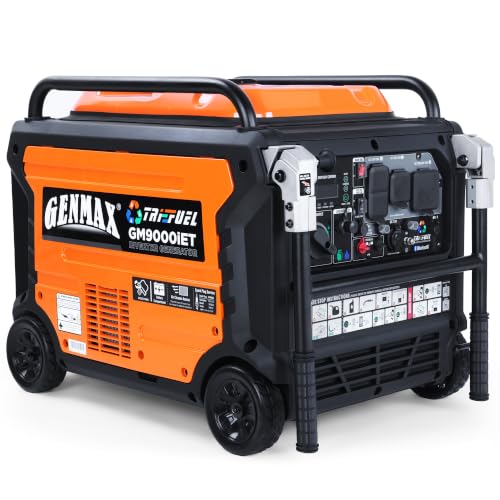
GENMAX 9000W Tri-Fuel Inverter Generator with Bluetooth and Two-Wire Start (GM9000iET)
natural gas homes with bigger motor loads
Our take Check price for GENMAX 9000W Tri-Fuel Inverter Generator with Bluetooth and Two-Wire Start (GM9000iET) (opens in a new tab)

Best High-Output Value
Champion 11,000-Watt Remote Start Tri Fuel Portable Inverter Generator
high natural gas output on a 30A or 37.5A inlet
Our take Check price for Champion 11,000-Watt Remote Start Tri Fuel Portable Inverter Generator (opens in a new tab)

Best Built-In Safety Extras
DuroMax XP9500iHT 9,500-Watt Tri Fuel Portable Digital Inverter Generator
owners who want a 50A outlet and a large engine
Our take Check price for DuroMax XP9500iHT 9,500-Watt Tri Fuel Portable Digital Inverter Generator (opens in a new tab)
Why Each Pick Made the Cut
Best Overall1 of 6
Westinghouse 8200 Peak Watt Tri-Fuel Portable Inverter Generator (iGen8200TFc) on Amazon (opens in a new tab)
The strongest case for Westinghouse 8200 Peak Watt Tri-Fuel Portable Inverter Generator (iGen8200TFc) is lists running watts for gas, propane and natural gas.
Best for
- budget-minded home backup on a transfer switch
Why it made the shortlist
For budget-minded home backup on a transfer switch, this is one of the more relevant configurations in the shortlist. The documented setup centers on 6,600W gas, 5,280W natural gas, 14-50R 50A plus TT-30R, 17 hours at 25% load.
Its case starts with lists running watts for gas, propane and natural gas. Against the other 5 picks, the useful comparison starts with 6,600W gas, 5,280W natural gas and 14-50R 50A plus TT-30R. Those details show whether its configuration suits the job better than a neighboring recommendation.
The trade-off worth checking first is feature text does not mention a natural gas hose. Confirm the exact model number and included components before ordering. Check dimensions, compatibility and maintenance needs against the way you plan to use and store it.
Key dimensions & specs
- 6,600W gas, 5,280W natural gas
- 14-50R 50A plus TT-30R
- 17 hours at 25% load
Pros
- Lists running watts for gas, propane and natural gas
- Has a 50A outlet ready for a transfer switch
- Runs around 60 dBA at quarter load, per the listing
Cons
- Feature text does not mention a natural gas hose
- No automatic two-wire start or phone app control
Best for Automatic Start2 of 6
GENMAX 8000W Tri-Fuel Inverter Generator with 2-Wire Auto Start and 50A Outlet (GM8000iETC) on Amazon (opens in a new tab)
GENMAX 8000W Tri-Fuel Inverter Generator with 2-Wire Auto Start and 50A Outlet (GM8000iETC) is the better fit when unattended automatic start during outages.
Best for
- unattended automatic start during outages
Why it made the shortlist
The intended use case is unattended automatic start during outages. The documented setup centers on 6,000W gas, 4,800W natural gas, two-wire auto start, Bluetooth, 14-50R and L5-30R outlets.
What separates it on paper is five start methods including two-wire automatic start. Against the other 5 picks, the useful comparison starts with 6,000W gas, 4,800W natural gas and two-wire auto start, Bluetooth. Those details show whether its configuration suits the job better than a neighboring recommendation.
Before committing, account for listing does not state hoses are included. Confirm the exact model number and included components before ordering. Check dimensions, compatibility and maintenance needs against the way you plan to use and store it.
Key dimensions & specs
- 6,000W gas, 4,800W natural gas
- Two-wire auto start, Bluetooth
- 14-50R and L5-30R outlets
Pros
- Five start methods including two-wire automatic start
- Cheaper than the Champion 8500 by $44.99
- Digital display shows load, fuel level and runtime
- Includes both a 14-50R and an L5-30R outlet
Cons
- Listing does not state hoses are included
Best Hoses in the Box3 of 6
Champion 8500-Watt Remote Start Tri Fuel Portable Inverter Generator on Amazon (opens in a new tab)
Choose Champion 8500-Watt Remote Start Tri Fuel Portable Inverter Generator for ships with 25 ft natural gas and propane hoses.
Best for
- buyers who want hoses included
Why it made the shortlist
Champion 8500-Watt Remote Start Tri Fuel Portable Inverter Generator is positioned for buyers who want hoses included. The documented setup centers on hoses included for gas and propane, 80 ft wireless key fob, 13 hours, 64 dB(A).
The feature doing most of the work here is ships with 25 ft natural gas and propane hoses. At 80 ft wireless key fob, this is the shortest directly comparable option. It favors easier handling and storage, but gives up reach.
The practical constraint here is running watts per fuel are missing from the listing. Measure the actual run from the hookup or outlet to where the gear will sit before choosing this length, and leave slack for uneven sites.
Key dimensions & specs
- Hoses included for gas and propane
- 80 ft wireless key fob
- 13 hours, 64 dB(A)
Pros
- Ships with 25 ft natural gas and propane hoses
- Key fob starts it from 80 feet away
- Connects to energy storage and transfer systems
- Three-year warranty with lifetime tech support
Cons
- Running watts per fuel are missing from the listing
- Costs $145.99 more than the Westinghouse 8200
Best Natural Gas Output Under $1,7004 of 6
GENMAX 9000W Tri-Fuel Inverter Generator with Bluetooth and Two-Wire Start (GM9000iET) on Amazon (opens in a new tab)
GENMAX 9000W Tri-Fuel Inverter Generator with Bluetooth and Two-Wire Start (GM9000iET) makes the shortlist because 6,500W on natural gas, 1,700W above the GM8000.
Best for
- natural gas homes with bigger motor loads
Why it made the shortlist
This model is aimed at natural gas homes with bigger motor loads. The documented setup centers on 8,000W gas, 6,500W natural gas, 349 cc, 138 lb on wheels, two-wire start, Bluetooth.
The most useful documented advantage is 6,500W on natural gas, 1,700W above the GM8000. Against the other 5 picks, the useful comparison starts with 8,000W gas, 6,500W natural gas and 349 cc, 138 lb on wheels. Those details show whether its configuration suits the job better than a neighboring recommendation.
The main limitation to plan around is weighs 138 lb, heavy for solo loading. Confirm whether the stated figure refers to product weight or rated working capacity. Compare it with your lifting, transport and support requirements before deciding.
Key dimensions & specs
- 8,000W gas, 6,500W natural gas
- 349 cc, 138 lb on wheels
- Two-wire start, Bluetooth
Pros
- 6,500W on natural gas, 1,700W above the GM8000
- Two-wire automatic start supports unattended backup
- Includes 14-50R, L5-30R and two GFCI outlets
- Wheels and handle on a 138 lb frame
Cons
- Weighs 138 lb, heavy for solo loading
- Costs $200 more than the GENMAX GM8000iETC
Best High-Output Value5 of 6
Champion 11,000-Watt Remote Start Tri Fuel Portable Inverter Generator on Amazon (opens in a new tab)
The strongest case for Champion 11,000-Watt Remote Start Tri Fuel Portable Inverter Generator is natural gas and propane hoses are included.
Best for
- high natural gas output on a 30A or 37.5A inlet
Why it made the shortlist
For high natural gas output on a 30A or 37.5A inlet, this is one of the more relevant configurations in the shortlist. The documented setup centers on 9,000W gas, 7,290W natural gas, 30A locking and 37.5A outlets, hoses and 80 ft key fob.
Its case starts with natural gas and propane hoses are included. At Hoses and 80 ft key fob, this is the shortest directly comparable option. It favors easier handling and storage, but gives up reach.
The trade-off worth checking first is no 50A outlet appears in the listing. Measure the actual run from the hookup or outlet to where the gear will sit before choosing this length, and leave slack for uneven sites.
Key dimensions & specs
- 9,000W gas, 7,290W natural gas
- 30A locking and 37.5A outlets
- Hoses and 80 ft key fob
Pros
- Natural gas and propane hoses are included
- CO Shield shuts the unit down automatically
- Costs $99.01 less than the DuroMax XP9500iHT
Cons
- No 50A outlet appears in the listing
- Costs $300 more than the GENMAX GM9000iET
Best Built-In Safety Extras6 of 6
DuroMax XP9500iHT 9,500-Watt Tri Fuel Portable Digital Inverter Generator on Amazon (opens in a new tab)
DuroMax XP9500iHT 9,500-Watt Tri Fuel Portable Digital Inverter Generator is the better fit when owners who want a 50A outlet and a large engine.
Best for
- owners who want a 50A outlet and a large engine
Why it made the shortlist
The intended use case is owners who want a 50A outlet and a large engine. The documented setup centers on 7,600W gasoline, 459 cc engine, 50 amp outlet, remote start, meters and parallel capability.
What separates it on paper is includes a 50A plug for transfer switch use. Against the other 5 picks, the useful comparison starts with 7,600W gasoline, 459 cc engine and 50 amp outlet, remote start. Those details show whether its configuration suits the job better than a neighboring recommendation.
Before committing, account for most expensive of the six at $2,099. Confirm the exact model number and included components before ordering. Check dimensions, compatibility and maintenance needs against the way you plan to use and store it.
Key dimensions & specs
- 7,600W gasoline, 459 cc engine
- 50 amp outlet, remote start
- Meters and parallel capability
Pros
- Includes a 50A plug for transfer switch use
- Copper windings and boron cast-iron sleeve stated
- Hour and voltage meters on the digital panel
- Automatic low oil and CO shutdown built in
Cons
- Most expensive of the six at $2,099
- Propane and natural gas watts are not listed
How We Built This Shortlist
Each pick was assessed across 5 criteria weighted for real-world use.
- Output on each fuel
- We read the running watts for gasoline, propane and natural gas on each listing, and noted where a page publishes only one number, since a tri-fuel rating is really three ratings.
- Outlets for a transfer switch
- We checked whether a 14-50R 50A, an L14-30R or an L5-30R outlet is named, because the outlet decides how the unit connects to a home panel or inlet.
- Hoses and fuel hookup
- We looked at whether natural gas and propane hoses are in the box or left as a separate purchase, since that affects first-day readiness and total cost.
- Start and control options
- Remote key fobs, Bluetooth apps and two-wire automatic start were compared, since unattended operation is the main reason to pay for tri-fuel at home.
- Price against stated output
- We compared the $1,399 to $2,099.00 spread against natural gas watts, which is the number most buyers are really buying.
What Matters Before You Choose a Tri-Fuel Inverter Generator
Key buying criteria so you get the right fit the first time.
Running watts on each fuel
A tri-fuel generator has three separate ratings, and the advertised figure is almost always the gasoline one. Natural gas is a lean fuel, so listings show roughly 19 to 20 percent less, such as 5,280 watts against 6,600 for the Westinghouse iGen8200TFc. Read the bullet that lists all three and size your loads to the natural gas number if that is the fuel you will burn.
Natural gas hookup and hoses
Natural gas connects through a hose to a low-pressure supply, and not every box includes the hose. Without it the first outage becomes a shopping trip, and a permanent connection should be installed to local code. Check the listing for a named gas hose length, as on the Champion 11000, and confirm whether a regulator comes with it.
Outlet type for your inlet
Transfer switches and generator inlets use specific plugs, and a 50A 14-50R does not mate with a 30A or 37.5A outlet without an adapter. A mismatch can force you to buy cords or rework the panel. Compare the outlet names on the listing to the receptacle you have, noting that the Champion 11000 lists 30A and 37.5A outlets rather than a 50A.
Automatic start capability
Two-wire start lets a compatible transfer system start the engine when the utility drops, which matters if you are away or asleep during an outage. A manual-start unit sits idle until someone is there. Look for the words two-wire or ATS start, as on the GENMAX 8000 and 9000, and confirm your transfer system supports it.
Weight and placement
A large tri-fuel inverter generator is a stationary appliance in practice, since the GENMAX GM9000iET weighs 138 lb on four wheels. A unit that cannot be rolled to a safe spot outdoors becomes a hazard because carbon monoxide must stay away from windows and doors. Look for the listed weight and the wheel kit, and plan a path to a spot well clear of any opening.
Runtime at your actual load
Runtime claims are stated at a specific load, often 25 percent, and the figure shrinks quickly as load grows. The Westinghouse iGen8200TFc claims up to 17 hours on 3.9 gallons at 25 percent, but a household with an air conditioner running sits well above that load. Match the runtime claim to the load you will really run, and treat half the listed hours as a cautious planning figure when load is higher.
Match a Tri-Fuel Inverter Generator to Your RV
By Fuel Plan
Decide which fuel you will actually burn most often, then size to that fuel's rating.
| Your situation | Recommended pick | Why |
|---|---|---|
| Natural gas is the main fuel, big motor loads | Champion 11000 | 7,290W on natural gas, the highest listed |
| Natural gas main fuel, mid-size home | GENMAX GM9000iET | 6,500W on natural gas from a 349 cc engine |
| Propane first, natural gas occasionally | Westinghouse iGen8200TFc | 5,940W propane, 5,280W natural gas, lowest price |
| Gasoline stored, propane as backup | GENMAX GM8000iETC | 6,000W gasoline and 5,500W propane |
| Want hoses ready with no extra buying | Champion 8500 | 25 ft natural gas and 6.6 ft propane hoses included |
Scroll sideways to see every column.
By Budget
| Budget | Recommended pick |
|---|---|
| Under $1,450 | Westinghouse iGen8200TFc |
| $1,450 to $1,550 | GENMAX GM8000iETC or Champion 8500 |
| $1,550 to $1,750 | GENMAX GM9000iET |
| $1,950 to $2,100 | Champion 11000 or DuroMax XP9500iHT |
Natural Gas Line vs Propane Cylinders
- Natural gas line
- The utility supply does not run out in a long outage the way a tank does, but every unit with a published rating loses about 19 to 20 percent of its gasoline output, such as the GENMAX GM8000iETC falling from 6,000 to 4,800 watts and the Champion 11000 from 9,000 to 7,290 watts. A permanent connection also needs proper fittings and a qualified installer under local rules.
- Propane cylinders
- Propane costs a smaller loss of roughly 8 to 10 percent, such as the Westinghouse iGen8200TFc going from 6,600 to 5,940 watts, and the fuel is portable. The tradeoff is cylinder size: a small cylinder will not last a multi-day outage at high load, so you must plan refills.
Most home backup buyers should size for the natural gas rating, since it is the lowest of the three, and treat the other two fuels as bonuses.
By Start and Transfer Setup
| Your setup | Recommended pick | Why |
|---|---|---|
| Automatic start from a compatible transfer system | GENMAX GM8000iETC | Two-wire auto start listed at $1,499.99 |
| Automatic start plus more natural gas output | GENMAX GM9000iET | Same two-wire start with 6,500W on natural gas |
| Energy storage or transfer switch connection | Champion 8500 | Listed to connect to storage systems and automatic transfer switches |
| Manual interlock kit with a 50A inlet | Westinghouse iGen8200TFc | 14-50R 50A outlet at the lowest price |
| Large 50A inlet and a bigger engine | DuroMax XP9500iHT | 50 amp plug with a 459 cc engine |
Scroll sideways to see every column.
For Whole-House Natural Gas Backup Specifically
- Look for
- A natural gas running watt number on the listing, a hose or regulator in the box, and an outlet that matches your inlet (14-50R for most home setups).
- In this comparison
- The Champion 11000 leads on natural gas at 7,290 watts with hoses included, the GENMAX GM9000iET gives 6,500 watts, and the Westinghouse iGen8200TFc gives 5,280 watts at the lowest price. The DuroMax XP9500iHT and Champion 8500 do not list natural gas watts in their feature text.
When to Spend More
- Spend more if
- You depend on a central air conditioner or well pump on natural gas; the Champion 11000 at $1,999.99 or the GENMAX GM9000iET at $1,699.99 offers 7,290 and 6,500 watts where the lighter units fall near or below 5,300.
- Save if
- You only need a refrigerator, lights and electronics, which the Westinghouse iGen8200TFc at $1,399 covers with a 50A outlet and a published 5,280 watts on natural gas.
Before You Bring One Home
Is tri-fuel worth it over dual fuel?
Only if you will connect a natural gas line. Natural gas adds a fuel that does not run out in a long outage, but it costs about 19 to 20 percent of gasoline output on the units listed here. If you only use gasoline and propane, a dual fuel unit is simpler and usually cheaper.
Do these generators work with a transfer switch?
Several list 50A outlets and transfer switch or interlock readiness, including the Westinghouse iGen8200TFc and the GENMAX models. The Champion 11000 lists 30A and 37.5A outlets, so match the outlet to your inlet before you buy.
How do I switch fuels?
Most tri-fuel units use a selector switch or dial and a connected hose for the alternate fuel. Shut the engine down and follow the manual before changing the hose or switch, and never connect a gas hose while the engine runs.
Can I run it indoors or in a garage?
No. Carbon monoxide is the main hazard of any generator. The CO sensors listed on these models shut the unit down but do not replace placing it outdoors, away from windows, doors and vents.
How often does the fuel need attention?
Gasoline left in the carburetor goes stale over months, while propane and natural gas do not. Shutting the unit down while it runs on propane or natural gas helps empty the carburetor of old gasoline, and a short exercise run keeps parts moving.
Does a bigger number mean it will start my air conditioner?
Not necessarily. The air conditioner's starting surge must fit within the peak rating for the fuel you use, and the natural gas peak is lower than the gasoline peak. Check the starting amps on the air conditioner's label and compare to the natural gas peak, not the headline watts.
Bottom Line
Best overall: Westinghouse 8200 Peak Watt Tri-Fuel Portable Inverter Generator (iGen8200TFc) — best overall pick in this roundup. See the full verdicts above for every pick, with pros, cons and who each one suits.
Browse all tri-fuel inverter generators on Amazon — Prime-eligible options with current pricing.