
Buying Guide
6 Best 48V Lithium Batteries for RV in 2026: A Practical RV Guide
Six true 48V (51.2V) 100Ah LiFePO4 batteries for coaches and large RV banks compared on BMS amps, inverter communication, listings and cost, $560 to $900.
By Hardcastle's RV Editors
11 min read6 products evaluated
A 48V lithium battery is not an upgrade for a typical travel trailer, whose house system runs at 12 volts. It belongs in a different kind of RV build: a large coach, a conversion with a 48V inverter-charger, or a fixed solar and backup system where the battery lives in a rack. At 48 volts the same 2,000 watts is only about 42 amps, so cables stay thin and a 5,120-watt battery can run an inverter that would need a very heavy 12V bank.
We compared six 51.2V (48V class) 100Ah LiFePO4 batteries priced from $559.99 to $899.99, each rated at 5.12kWh. Cost per nominal kilowatt-hour runs from about $109 to $176, and the real differences are the communication ports, safety listings, BMS current, size and how you would mount a battery of roughly 90 to 100 pounds in a vehicle. Most of these are home-storage rack batteries, and we say so where a listing treats RV use lightly.
Hardcastle’s RV field notes
The Rig Fit Check
A quick way to connect the shortlist to the space, workload and ownership details that matter after the box arrives.
- Start with the job
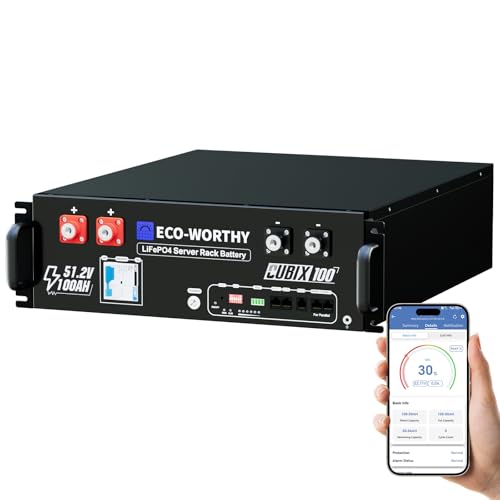
- ECO-WORTHY Cubix100 48V 100Ah LiFePO4 Lithium UL9540 Server Rack Battery leads this shortlist for fixed installs needing safety listings. Use that fit as a reference point, then compare the alternatives against your own space and workload.
- Specs that separate the picks
- The first details to compare are 51.2V 100Ah, 5.12kWh, 51.2V 100Ah 3U rack, 19.09 x 17.72 x 5.24 inches. Confirm the exact model and included components before ordering.
- Trade-off to plan for
- Costs $330 more than the cheapest 48V rack battery
The Practical Shortlist
A road-tested-thinking look at 6 options, organized around the job each one suits best.
Best Certified
ECO-WORTHY Cubix100 48V 100Ah LiFePO4 Lithium UL9540 Server Rack Battery
fixed installs needing safety listings
Our take Check price for ECO-WORTHY Cubix100 48V 100Ah LiFePO4 Lithium UL9540 Server Rack Battery (opens in a new tab)
Best Value With App
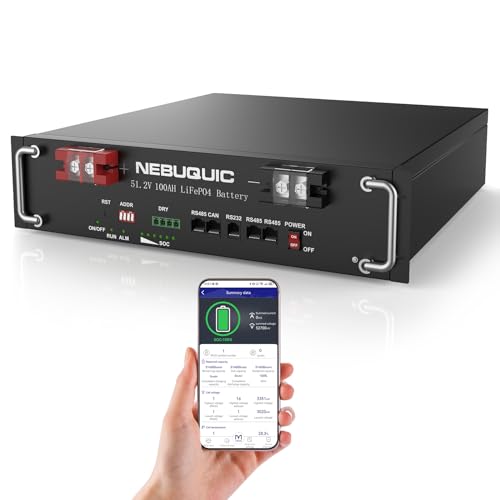
NebuQuic 48V (51.2V) 100Ah LiFePO4 Lithium Battery 5.12kWh 3U Rack Mount with 100A BMS and Bluetooth APP
budget-conscious 48V installs wanting an app
Our take Check price for NebuQuic 48V (51.2V) 100Ah LiFePO4 Lithium Battery 5.12kWh 3U Rack Mount with 100A BMS and Bluetooth APP (opens in a new tab)

Best for Victron Systems
Wattcycle 51.2V 100Ah LiFePO4 Battery 100A BMS Rack Mount Bluetooth
Victron-based coach systems needing exact dimensions
Our take Check price for Wattcycle 51.2V 100Ah LiFePO4 Battery 100A BMS Rack Mount Bluetooth (opens in a new tab)
Best High-Current BMS
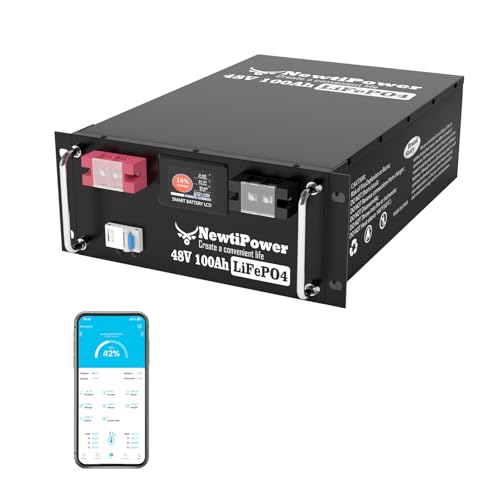
NewtiPower 48V 100Ah LiFePO4 Server Rack Battery 5120Wh Energy
single-battery banks feeding a large inverter
Our take Check price for NewtiPower 48V 100Ah LiFePO4 Server Rack Battery 5120Wh Energy (opens in a new tab)

Lowest Price
DATOUBOSS 48V 100Ah LiFePO4 Lithium Battery, 5.12kWh 3U Server Rack Battery
buyers comparing capacity, compatibility, included components and storage needs
Our take Check price for DATOUBOSS 48V 100Ah LiFePO4 Lithium Battery, 5.12kWh 3U Server Rack Battery (opens in a new tab)

Best Non-Rack Alternative
TEMGO 48V (51.2V) 100Ah LiFePO4 Lithium Golf Cart Battery
48V systems with a plain controller and no inverter data link
Our take Check price for TEMGO 48V (51.2V) 100Ah LiFePO4 Lithium Golf Cart Battery (opens in a new tab)
Why Each Pick Made the Cut
Best Certified1 of 6
ECO-WORTHY Cubix100 48V 100Ah LiFePO4 Lithium UL9540 Server Rack Battery on Amazon (opens in a new tab)
The strongest case for ECO-WORTHY Cubix100 48V 100Ah LiFePO4 Lithium UL9540 Server Rack Battery is uL9540, UL1973 and CEC listings are stated up front.
Best for
- fixed installs needing safety listings
Why it made the shortlist
For fixed installs needing safety listings, this is one of the more relevant configurations in the shortlist. The documented setup centers on 51.2V 100Ah, 5.12kWh, uL9540, UL1973, CEC listed, cAN, RS485, Bluetooth, WiFi.
Its case starts with uL9540, UL1973 and CEC listings are stated up front. Its 51.2V 100Ah, 5.12kWh specification sits at the same documented level as the comparable picks in this 5-product comparison. Treat the battery platform and included charger as part of the fit, not just the headline number.
The trade-off worth checking first is costs $330 more than the cheapest 48V rack battery. Confirm whether the battery and charger are included with the exact package. Check platform compatibility and published runtime against the area or workload you need to cover.
Key dimensions & specs
- 51.2V 100Ah, 5.12kWh
- UL9540, UL1973, CEC listed
- CAN, RS485, Bluetooth, WiFi
Pros
- UL9540, UL1973 and CEC listings are stated up front
- Plug-and-play kit includes parallel and communication cables
- Ten-year limited warranty is the longest stated here
- Parallels up to 32 units for 163.8kWh
Cons
- Costs $330 more than the cheapest 48V rack battery
- Weight and dimensions are not in the listing text
Best Value With App2 of 6
NebuQuic 48V (51.2V) 100Ah LiFePO4 Lithium Battery 5.12kWh 3U Rack Mount with 100A BMS and Bluetooth APP on Amazon (opens in a new tab)
NebuQuic 48V (51.2V) 100Ah LiFePO4 Lithium Battery 5.12kWh 3U Rack Mount with 100A BMS and Bluetooth APP is the better fit when budget-conscious 48V installs wanting an app.
Best for
- budget-conscious 48V installs wanting an app
Why it made the shortlist
The intended use case is budget-conscious 48V installs wanting an app. The documented setup centers on 51.2V 100Ah 3U rack, bluetooth app, CAN, RS485, 6,000 plus cycles claimed.
What separates it on paper is bluetooth app shows voltage, current and temperature. Its 51.2V 100Ah 3U rack specification sits at the same documented level as the comparable picks in this 5-product comparison. Treat the battery platform and included charger as part of the fit, not just the headline number.
Before committing, account for weight and size are not given in the listing. Confirm whether the battery and charger are included with the exact package. Check platform compatibility and published runtime against the area or workload you need to cover.
Key dimensions & specs
- 51.2V 100Ah 3U rack
- Bluetooth app, CAN, RS485
- 6,000 plus cycles claimed
Pros
- Bluetooth app shows voltage, current and temperature
- UL9540A and CEC certification stated in the listing
- CAN and RS485 ports for inverter communication
- About $131 per kilowatt-hour with an app
Cons
- Weight and size are not given in the listing
- 100A BMS limits one battery to about 5,120W
Best for Victron Systems3 of 6
Wattcycle 51.2V 100Ah LiFePO4 Battery 100A BMS Rack Mount Bluetooth on Amazon (opens in a new tab)
Choose Wattcycle 51.2V 100Ah LiFePO4 Battery 100A BMS Rack Mount Bluetooth for weight and size are stated: 91.9 pounds, 3U rack.
Best for
- Victron-based coach systems needing exact dimensions
Why it made the shortlist
Wattcycle 51.2V 100Ah LiFePO4 Battery 100A BMS Rack Mount Bluetooth is positioned for Victron-based coach systems needing exact dimensions. The documented setup centers on 19.09 x 17.72 x 5.24 inches, 91.9 lb, 5,120Wh, lCD, Bluetooth, CAN, RS485.
The feature doing most of the work here is weight and size are stated: 91.9 pounds, 3U rack. Against the other 5 picks, the useful comparison starts with 19.09 x 17.72 x 5.24 inches and 91.9 lb, 5,120Wh. Those details show whether its configuration suits the job better than a neighboring recommendation.
The practical constraint here is no safety listing is named in the listing text. Measure the narrowest access point and the available storage footprint before ordering. Confirm what the stated dimension refers to on the exact model and configuration.
Key dimensions & specs
- 19.09 x 17.72 x 5.24 inches
- 91.9 lb, 5,120Wh
- LCD, Bluetooth, CAN, RS485
Pros
- Weight and size are stated: 91.9 pounds, 3U rack
- Victron and Schneider inverter compatibility is named
- Works from minus 4°F to 149°F in a metal case
- LCD touchscreen shows status on the battery itself
Cons
- No safety listing is named in the listing text
Best High-Current BMS4 of 6
NewtiPower 48V 100Ah LiFePO4 Server Rack Battery 5120Wh Energy on Amazon (opens in a new tab)
NewtiPower 48V 100Ah LiFePO4 Server Rack Battery 5120Wh Energy makes the shortlist because 200A BMS supports about 10kW from one battery.
Best for
- single-battery banks feeding a large inverter
Why it made the shortlist
This model is aimed at single-battery banks feeding a large inverter. The documented setup centers on 51.2V 100Ah, 200A BMS, 10.2kW maximum continuous load, parallel up to 6 units.
The most useful documented advantage is 200A BMS supports about 10kW from one battery. Its 51.2V 100Ah, 200A BMS specification sits at the same documented level as the comparable picks in this 5-product comparison. Treat the battery platform and included charger as part of the fit, not just the headline number.
The main limitation to plan around is weight and dimensions are not given in the listing. Confirm whether the battery and charger are included with the exact package. Check platform compatibility and published runtime against the area or workload you need to cover.
Key dimensions & specs
- 51.2V 100Ah, 200A BMS
- 10.2kW maximum continuous load
- Parallel up to 6 units
Pros
- 200A BMS supports about 10kW from one battery
- Ten-year warranty is activated with the serial number
- Parallel up to six units for 600Ah
- Lists RV and travel trailer use
Cons
- Weight and dimensions are not given in the listing
- No UL listing is named, unlike ECO-WORTHY
Lowest Price5 of 6
DATOUBOSS 48V 100Ah LiFePO4 Lithium Battery, 5.12kWh 3U Server Rack Battery on Amazon (opens in a new tab)
The strongest case for DATOUBOSS 48V 100Ah LiFePO4 Lithium Battery, 5.12kWh 3U Server Rack Battery is weight stated at 94.8 pounds for one-person handling.
Best for
- buyers comparing capacity, compatibility, included components and storage needs
Why it made the shortlist
For buyers comparing capacity, compatibility, included components and storage needs, this is one of the more relevant configurations in the shortlist. The documented setup centers on 51.2V 100Ah, 94.8 lb, rS232, RS485, CAN ports, cabling kit included.
Its case starts with weight stated at 94.8 pounds for one-person handling. Its 51.2V 100Ah, 94.8 lb specification sits at the same documented level as the comparable picks in this 5-product comparison. Treat the battery platform and included charger as part of the fit, not just the headline number.
The trade-off worth checking first is no safety listing named in the listing text. Confirm whether the battery and charger are included with the exact package. Check platform compatibility and published runtime against the area or workload you need to cover.
Key dimensions & specs
- 51.2V 100Ah, 94.8 lb
- RS232, RS485, CAN ports
- Cabling kit included
Pros
- Weight stated at 94.8 pounds for one-person handling
- RS232, RS485 and CAN suit most 48V inverters
- Parallel, communication and ground cables included
Cons
- No safety listing named in the listing text
- Fewer monitoring details than NebuQuic or Wattcycle
Best Non-Rack Alternative6 of 6
TEMGO 48V (51.2V) 100Ah LiFePO4 Lithium Golf Cart Battery on Amazon (opens in a new tab)
TEMGO 48V (51.2V) 100Ah LiFePO4 Lithium Golf Cart Battery is the better fit when 48V systems with a plain controller and no inverter data link.
Best for
- 48V systems with a plain controller and no inverter data link
Why it made the shortlist
The intended use case is 48V systems with a plain controller and no inverter data link. The documented setup centers on 51.2V 100Ah, 200A BMS, 58.4V 18A charger included, 10.24kW peak output.
What separates it on paper is charger and LCD display come in the box. Its 51.2V 100Ah, 200A BMS specification sits at the same documented level as the comparable picks in this 5-product comparison. Treat the battery platform and included charger as part of the fit, not just the headline number.
Before committing, account for listing mentions no inverter communication ports. Confirm whether the battery and charger are included with the exact package. Check platform compatibility and published runtime against the area or workload you need to cover.
Key dimensions & specs
- 51.2V 100Ah, 200A BMS
- 58.4V 18A charger included
- 10.24kW peak output
Pros
- Charger and LCD display come in the box
- 200A continuous and 600A for three seconds
- Bluetooth app on the 200A BMS
- Parallels up to four units for 20.48kWh
Cons
- Listing mentions no inverter communication ports
- Built for golf carts, so RV use needs checking
How We Built This Shortlist
Each pick was assessed across 5 criteria weighted for real-world use.
- True 48V class rating
- We kept only batteries of 51.2V nominal with 100Ah, which is 5,120Wh, and excluded 12V and 24V units that can only be wired into a 48V string.
- Inverter communication
- We checked which listings state CAN, RS485 or RS232 ports, and whether any inverter brand is named, since a rack battery with no data link needs manual charge settings.
- BMS current in watts
- We converted BMS amps to watts at 51.2V, so 100A is about 5,120W and 200A about 10,240W, and compared that with the inverter size.
- Safety listings and documentation
- We noted stated UL9540, UL9540A, UL1973 and CEC listings and treated a missing listing as undocumented rather than absent.
- Weight, size and mounting
- We looked for stated weight and dimensions, since a 92 to 100 pound battery in a moving vehicle needs a proper mount and the listings rarely cover vibration.
What Matters Before You Choose a 48V Lithium Battery for RV
Key buying criteria so you get the right fit the first time.
Is it really a 48V system?
A 48V LiFePO4 battery is 16 cells in series, which gives 51.2V nominal and about 58.4V when charged. A listing that says 48V and shows 51.2V or 58.4V is a true 48V-class battery, while a 12V or 24V unit that merely supports series wiring is not. Check the voltage line in the bullet points and the charger voltage, since a 48V battery needs a 58.4V lithium charger or inverter-charger setting.
System voltage compatibility
A 48V battery only works with a 48V inverter-charger, 48V solar controller and 48V chargers, and RV 12V converters, alternators and appliances will not connect to it. You also need a 48V-to-12V DC converter for lights, pumps and a fridge, and that converter adds some loss. List every 12V load before choosing, and confirm a converter exists for the total current.
Inverter communication ports
CAN, RS485 and RS232 let the battery tell the inverter its charge limit and state of charge, so the system can stop charging on cell limits rather than a guessed voltage. Without them you set voltages by hand. Check which protocol and brand your inverter supports, and look for a communication cable in the box, since some listings omit it.
BMS current in watts
A 100A BMS at 51.2V supports about 5,120 watts, and a 200A BMS about 10,240 watts. An 8,000W inverter will draw around 167A at 48V, which exceeds a 100A BMS, so the battery shuts down under load. Match the continuous rating, not the peak, and add batteries in parallel to raise the limit.
Weight and mounting in a vehicle
Rack batteries here weigh about 92 to 95 pounds where weight is stated, and they are made for a stationary cabinet. In a moving RV the listings we reviewed do not describe vibration testing, so plan a strap-down frame fixed to the structure and keep terminals protected. Confirm weight and dimensions, and plan for two people to lift it.
Safety listings and what they mean
UL1973 covers the battery, UL9540A is a thermal runaway test method, and UL9540 covers an energy storage system, so they are not interchangeable. A listing that names them gives you paperwork for insurers and inspectors, while one that does not leaves the question open. Ask the seller for the certificate number before you rely on a claim.
Match a 48V Lithium Battery for RV to Your RV
By Inverter Size
| Your situation | Recommended pick | Why |
|---|---|---|
| Inverter up to about 5,000W | NebuQuic 48V | 100A BMS covers about 5,120W, with app and UL9540A |
| Inverter 6,000W to 10,000W on one battery | NewtiPower 48V | 200A BMS and 10.2kW stated load |
| Cheapest battery for a small 48V inverter | DATOUBOSS 48V | $559.99 with CAN, RS485 and RS232 |
| Victron or Schneider inverter-charger | Wattcycle 51.2V | Names both brands and lists CAN, RS485, RS232 |
| Inverter or controller with no data link | TEMGO 48V | 200A BMS, charger included, no communication ports |
Scroll sideways to see every column.
By Budget
| Budget | Recommended pick |
|---|---|
| Under $600 | DATOUBOSS 48V ($559.99) |
| $600 to $750 | NebuQuic 48V ($669.99) or NewtiPower 48V ($729.99) |
| $750 to $800 | TEMGO 48V ($769.49) |
| $890 to $900 | ECO-WORTHY Cubix100 ($889.99) or Wattcycle 51.2V ($899.99) |
Rack-Mount vs Golf-Cart-Style Case
- Rack-mount
- A 3U rack battery slides into a cabinet or shelf, usually carries CAN and RS485 ports and can be paralleled with identical units, but weighs about 92 to 95 pounds and needs a strap-down or frame in a vehicle. NebuQuic, DATOUBOSS, NewtiPower, ECO-WORTHY and Wattcycle are all rack format.
- Golf-cart-style case
- A sealed ABS block with a handle and usually a charger in the box, aimed at a simple 48V controller. TEMGO is the one here, and its listing mentions no inverter communication ports.
If a modern 48V inverter-charger is in your plan, buy a rack battery with communication. Use the golf-cart-style case only for simple 48V loads.
By How Much Documentation You Need
| What you need to show | Recommended pick |
|---|---|
| UL9540, UL1973 and CEC on the listing | ECO-WORTHY Cubix100 |
| UL9540A and CEC with an app | NebuQuic 48V |
| Exact weight and dimensions for a mount | Wattcycle 51.2V (91.9 lb, 19.09 x 17.72 x 5.24 inches) |
| Warranty paperwork you can activate | NewtiPower 48V (ten-year activable warranty) |
For a Large Motorhome or Coach Specifically
- Look for
- A BMS that matches your inverter (100A for about 5,120W, 200A for about 10,240W), a communication port that your inverter supports, a stated weight so you can plan a floor-supported mount, and a stated operating temperature. A 48V battery also needs a 48V inverter-charger and a way to run 12V loads through a DC converter.
- In this comparison
- Wattcycle 51.2V is the only pick that states both weight and temperature range, NewtiPower 48V has the 200A BMS for the largest loads, and ECO-WORTHY Cubix100 has the full set of safety listings.
When to Spend More
- Spend more if
- You need to show UL listings, name your inverter brand or plan a large bank: ECO-WORTHY Cubix100 states three listings, Wattcycle 51.2V names Victron and Schneider, and NewtiPower 48V doubles the BMS current.
- Save if
- Your inverter is modest and the battery sits in a protected space: DATOUBOSS 48V at $559.99 and NebuQuic 48V at $669.99 give 5.12kWh for the least, and NebuQuic adds an app.
Before You Bring One Home
Do I need a 48V lithium battery in my RV?
Only if your system is 48V already, or you are designing a large inverter-based build. Most RVs run 12V house loads, so a 48V battery needs a 48V inverter-charger and a DC converter for 12V loads.
Can I use a 48V rack battery in a moving RV?
Some owners do, but the listings we reviewed describe home energy storage and do not mention vibration testing. Secure the battery with a rigid frame and straps, keep it level and check the terminals regularly.
Is 48V better than four 12V batteries in series?
A single 51.2V battery has one BMS and no balancing between separate batteries, while four 12V batteries give you flexibility to reconfigure. A rack battery also carries communication ports, which most 12V batteries do not.
How do I connect a 48V battery to my inverter?
Use a breaker or fuse rated for the maximum current, wire positive and negative to the inverter with correct cable size, and connect the communication cable to the inverter's battery port. Then pick the matching battery profile in the inverter settings.
How many 48V batteries can I parallel?
It depends on the listing: NewtiPower states six, TEMGO four, Wattcycle sixteen, and ECO-WORTHY thirty-two. Use identical units and confirm the warranty applies to a multi-battery bank.
How should I store a 48V lithium battery?
Store at roughly 50 to 80 percent charge, switched off, in a space within the temperature range on the listing. Recheck it every couple of months, since the BMS and communication board draw a small standby current.
Bottom Line
Best overall: ECO-WORTHY Cubix100 48V 100Ah LiFePO4 Lithium UL9540 Server Rack Battery — best certified pick in this roundup. See the full verdicts above for every pick, with pros, cons and who each one suits.
Browse all 48v lithium batteries for rv on Amazon — Prime-eligible options with current pricing.