
Buying Guide
6 Best RV Batteries for Dry Camping in 2026: A Practical RV Guide
We compared self-heating and mid-size 100Ah to 160Ah lithium RV batteries for dry camping weekends, from cold-weather charging to group 24 and 27 fit.
By Hardcastle's RV Editors
10 min read6 products evaluated
Dry camping usually means a weekend or a few nights at a state park, fairground, or Harvest Hosts stop without hookups, often with a generator or limited solar. You need enough battery to run the furnace fan, lights, and water pump through a couple of cold nights, not a huge off-grid power plant.
That is why this roundup centers on 100Ah to 160Ah lithium batteries that drop into a standard group 24, 27, or 31 tray, with extra weight on self-heating models that can still accept a charge on frosty mornings. We evaluated picks from LiTime, Renogy, Power Queen, Redodo, and HumsiENK on heater design, low-temperature behavior, usable energy, tray fit, and buyer feedback.
Hardcastle’s RV field notes
The Rig Fit Check
A quick way to connect the shortlist to the space, workload and ownership details that matter after the box arrives.
- Start with the job
- LiTime 12V 100Ah Self-Heating LiFePO4 Battery, Group 24, Bluetooth leads this shortlist for Weekend dry campers who camp in fall, winter, and spring. Use that fit as a reference point, then compare the alternatives against your own space and workload.
- Specs that separate the picks
- The first details to compare are 12V 100Ah, group 24 fit, 12V 100Ah, group 22NF, 12V 150Ah, 1920Wh. Confirm the exact model and included components before ordering.
- Trade-off to plan for
- Pricier than non-heated 100Ah batteries
The Practical Shortlist
A road-tested-thinking look at 6 options, organized around the job each one suits best.

Best Overall
LiTime 12V 100Ah Self-Heating LiFePO4 Battery, Group 24, Bluetooth
Weekend dry campers who camp in fall, winter, and spring
Our take Check price for LiTime 12V 100Ah Self-Heating LiFePO4 Battery, Group 24, Bluetooth (opens in a new tab)

Best for Freezing Weather
Renogy 12V 100Ah Self-Heating LiFePO4 Battery with DuoHeat, Group 22NF
Cold-climate campers who charge on frosty mornings
Our take Check price for Renogy 12V 100Ah Self-Heating LiFePO4 Battery with DuoHeat, Group 22NF (opens in a new tab)

Best Capacity in Group 27
Power Queen 12V 150Ah LiFePO4 Group 27 Battery with Bluetooth
Dry campers wanting a full weekend without recharging
Our take Check price for Power Queen 12V 150Ah LiFePO4 Group 27 Battery with Bluetooth (opens in a new tab)
Best Group 24 Capacity
Redodo 12.8V 120Ah LiFePO4 Group 24 Battery with Bluetooth
Small trailers wanting extra capacity in a group 24 box
Our take Check price for Redodo 12.8V 120Ah LiFePO4 Group 24 Battery with Bluetooth (opens in a new tab)
Best Value Self-Heating
Redodo 12V 100Ah Self-Heating LiFePO4 Group 31 Battery
Cold-weather campers on a budget with a group 31 box
Our take Check price for Redodo 12V 100Ah Self-Heating LiFePO4 Group 31 Battery (opens in a new tab)
Best Budget High Capacity
HumsiENK 12V 160Ah LiFePO4 Battery, 150A BMS, 2048Wh
Generator-free weekends in mild weather on a budget
Our take Check price for HumsiENK 12V 160Ah LiFePO4 Battery, 150A BMS, 2048Wh (opens in a new tab)
Why Each Pick Made the Cut
Best Overall1 of 6
LiTime 12V 100Ah Self-Heating LiFePO4 Battery, Group 24, Bluetooth on Amazon (opens in a new tab)
The strongest case for LiTime 12V 100Ah Self-Heating LiFePO4 Battery, Group 24, Bluetooth is heats below 41F, then charges once cells reach 50F.
Best for
- Weekend dry campers who camp in fall, winter, and spring
Why it made the shortlist
For Weekend dry campers who camp in fall, winter, and spring, this is one of the more relevant configurations in the shortlist. The documented setup centers on 12V 100Ah, group 24 fit, two heating modes, iP65, 22.71 lbs.
Its case starts with heats below 41F, then charges once cells reach 50F. Its 12V 100Ah, group 24 fit specification sits at the same documented level as the comparable picks in this 6-product comparison. Treat the battery platform and included charger as part of the fit, not just the headline number.
The trade-off worth checking first is pricier than non-heated 100Ah batteries. Confirm whether the battery and charger are included with the exact package. Check platform compatibility and published runtime against the area or workload you need to cover.
Key dimensions & specs
- 12V 100Ah, group 24 fit
- Two heating modes
- IP65, 22.71 lbs
Pros
- Heats below 41F, then charges once cells reach 50F
- Two heating modes, including an energy-saving setting
- Group 24 size drops into most RV boxes
- Bluetooth app shows charge level
Cons
- Pricier than non-heated 100Ah batteries
- Bluetooth needs a charger to activate first
Best for Freezing Weather2 of 6
Renogy 12V 100Ah Self-Heating LiFePO4 Battery with DuoHeat, Group 22NF on Amazon (opens in a new tab)
Renogy 12V 100Ah Self-Heating LiFePO4 Battery with DuoHeat, Group 22NF is the better fit when cold-climate campers who charge on frosty mornings.
Best for
- Cold-climate campers who charge on frosty mornings
Why it made the shortlist
The intended use case is Cold-climate campers who charge on frosty mornings. The documented setup centers on 12V 100Ah, group 22NF, 110W dual heating pads, operates -22F to 131F.
What separates it on paper is 110W dual heaters warm cells 40% faster. Its 12V 100Ah, group 22NF specification sits at the same documented level as the comparable picks in this 6-product comparison. Treat the battery platform and included charger as part of the fit, not just the headline number.
Before committing, account for no Bluetooth monitoring listed. Confirm whether the battery and charger are included with the exact package. Check platform compatibility and published runtime against the area or workload you need to cover.
Key dimensions & specs
- 12V 100Ah, group 22NF
- 110W dual heating pads
- Operates -22F to 131F
Pros
- 110W dual heaters warm cells 40% faster
- 45% smaller group 22NF footprint
- IP65 weatherproof case handles rain and dust
Cons
- No Bluetooth monitoring listed
- Group 22NF may need a tray spacer
Best Capacity in Group 273 of 6
Power Queen 12V 150Ah LiFePO4 Group 27 Battery with Bluetooth on Amazon (opens in a new tab)
Choose Power Queen 12V 150Ah LiFePO4 Group 27 Battery with Bluetooth for 50% more energy than 100Ah in the same tray.
Best for
- Dry campers wanting a full weekend without recharging
Why it made the shortlist
Power Queen 12V 150Ah LiFePO4 Group 27 Battery with Bluetooth is positioned for Dry campers wanting a full weekend without recharging. The documented setup centers on 12V 150Ah, 1920Wh, group 27 size, low-temp charge and discharge protection.
The feature doing most of the work here is 50% more energy than 100Ah in the same tray. Its 12V 150Ah, 1920Wh specification sits at the same documented level as the comparable picks in this 6-product comparison. Treat the battery platform and included charger as part of the fit, not just the headline number.
The practical constraint here is no heater, so it cannot charge in freezing cold. Confirm whether the battery and charger are included with the exact package. Check platform compatibility and published runtime against the area or workload you need to cover.
Key dimensions & specs
- 12V 150Ah, 1920Wh
- Group 27 size
- Low-temp charge and discharge protection
Pros
- 50% more energy than 100Ah in the same tray
- Bluetooth shows charge, temperature, and BMS status
- 1920W output runs a microwave on an inverter
- Replaces three 100Ah AGM batteries
Cons
- No heater, so it cannot charge in freezing cold
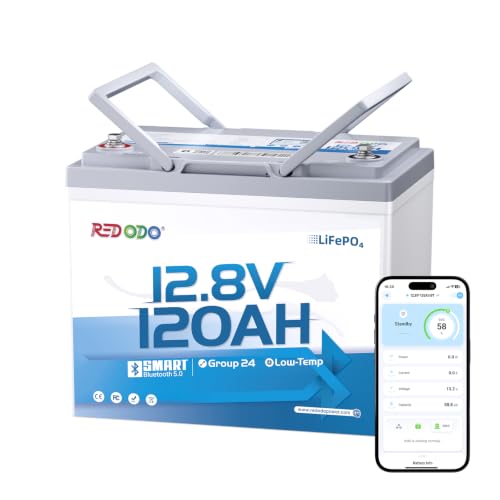
Best Group 24 Capacity4 of 6
Redodo 12.8V 120Ah LiFePO4 Group 24 Battery with Bluetooth on Amazon (opens in a new tab)
Redodo 12.8V 120Ah LiFePO4 Group 24 Battery with Bluetooth makes the shortlist because 120Ah fits a group 24 box.
Best for
- Small trailers wanting extra capacity in a group 24 box
Why it made the shortlist
This model is aimed at Small trailers wanting extra capacity in a group 24 box. The documented setup centers on 12V 120Ah, 1536Wh, group 24, 10.24 x 6.61 x 8.27 in, 120A BMS, IP65.
The most useful documented advantage is 120Ah fits a group 24 box. Its 12V 120Ah, 1536Wh specification sits at the same documented level as the comparable picks in this 6-product comparison. Treat the battery platform and included charger as part of the fit, not just the headline number.
The main limitation to plan around is no heater for cold charging. Confirm whether the battery and charger are included with the exact package. Check platform compatibility and published runtime against the area or workload you need to cover.
Key dimensions & specs
- 12V 120Ah, 1536Wh
- Group 24, 10.24 x 6.61 x 8.27 in
- 120A BMS, IP65
Pros
- 120Ah fits a group 24 box
- White case absorbs less heat in summer sun
- Bluetooth shows SOC, current, and alerts
- Charges fully in about 6 hours with 20A
Cons
- No heater for cold charging
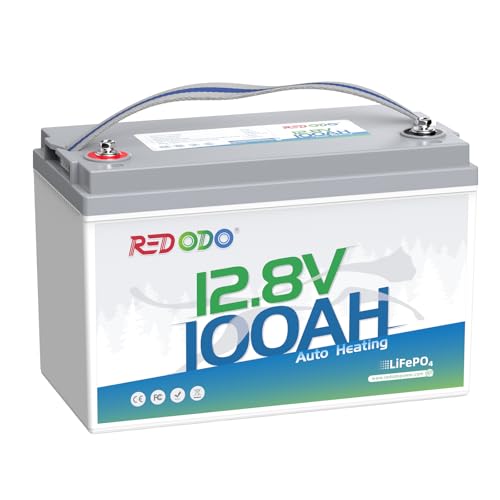
Best Value Self-Heating5 of 6
Redodo 12V 100Ah Self-Heating LiFePO4 Group 31 Battery on Amazon (opens in a new tab)
The strongest case for Redodo 12V 100Ah Self-Heating LiFePO4 Group 31 Battery is heats cells from 14F to 41F in about 30 minutes.
Best for
- Cold-weather campers on a budget with a group 31 box
Why it made the shortlist
For Cold-weather campers on a budget with a group 31 box, this is one of the more relevant configurations in the shortlist. The documented setup centers on 12V 100Ah, group 31, 100W dual heating pads, 23.32 lbs.
Its case starts with heats cells from 14F to 41F in about 30 minutes. Its 12V 100Ah, group 31 specification sits at the same documented level as the comparable picks in this 6-product comparison. Treat the battery platform and included charger as part of the fit, not just the headline number.
The trade-off worth checking first is no Bluetooth on this model. Confirm whether the battery and charger are included with the exact package. Check platform compatibility and published runtime against the area or workload you need to cover.
Key dimensions & specs
- 12V 100Ah, group 31
- 100W dual heating pads
- 23.32 lbs
Pros
- Heats cells from 14F to 41F in about 30 minutes
- Group 31 size fits common trailer trays
- Stops discharging in extreme cold to protect cells
Cons
- No Bluetooth on this model
- Less capacity than the 120Ah and 150Ah picks
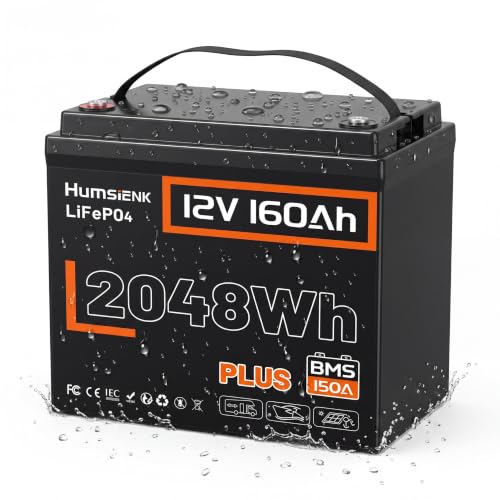
Best Budget High Capacity6 of 6
HumsiENK 12V 160Ah LiFePO4 Battery, 150A BMS, 2048Wh on Amazon (opens in a new tab)
HumsiENK 12V 160Ah LiFePO4 Battery, 150A BMS, 2048Wh is the better fit when generator-free weekends in mild weather on a budget.
Best for
- Generator-free weekends in mild weather on a budget
Why it made the shortlist
The intended use case is Generator-free weekends in mild weather on a budget. The documented setup centers on 12V 160Ah, 2048Wh, 150A BMS, 1920W output, 41.23 lbs, IP65.
What separates it on paper is 2048Wh is the most energy among these picks. Its 12V 160Ah, 2048Wh specification sits at the same documented level as the comparable picks in this 6-product comparison. Treat the battery platform and included charger as part of the fit, not just the headline number.
Before committing, account for not a standard group size at 10.07 x 7.66 x 9.99 in. Confirm whether the battery and charger are included with the exact package. Check platform compatibility and published runtime against the area or workload you need to cover.
Key dimensions & specs
- 12V 160Ah, 2048Wh
- 150A BMS, 1920W output
- 41.23 lbs, IP65
Pros
- 2048Wh is the most energy among these picks
- 150A BMS runs a fridge and small AC loads
- IP65 case rated for -4F to 140F use
Cons
- Not a standard group size at 10.07 x 7.66 x 9.99 in
- No heater or Bluetooth listed
How We Built This Shortlist
Each pick was assessed across 5 criteria weighted for real-world use.
- Cold Morning Charging
- We gave the most weight to self-heating designs and clearly stated charge cutoffs, since dry campers often recharge from a generator or solar on cold mornings.
- Weekend-Sized Capacity
- We compared usable energy against a typical two to three night dry camping trip, roughly 1000 to 2000Wh total.
- Standard Tray Fit
- We checked whether each battery drops into a group 24, 27, or 31 tray without modification.
- Monitoring
- We noted which picks include Bluetooth, since knowing your state of charge decides when to run the generator.
- Price per Watt-Hour
- We compared cost against stored energy, so heated and non-heated picks can be weighed fairly.
What Matters Before You Choose an RV Battery for Dry Camping
Key buying criteria so you get the right fit the first time.
Heater vs Cutoff
LiFePO4 cells can be damaged by charging below freezing, so batteries handle cold in one of two ways. A cutoff simply blocks charging, while a self-heating battery warms its cells using charger power and then charges. Look for wording like self-heating or heating pad wattage in the listing; low-temperature protection alone means no heater.
How Much Capacity a Weekend Needs
A furnace fan can draw several amps per hour on cold nights, and with lights, a water pump, and phone charging, many rigs use 40 to 80Ah per night. Two nights can therefore need 100 to 160Ah. Estimate your nightly use, then choose capacity in the listing's Wh figure divided by 12.8.
Generator Charging Speed
Dry campers often run a generator for a couple of hours in the morning, so how fast the battery accepts charge matters. Lithium accepts high current, but your converter's amp rating usually sets the speed, and many stock converters are 35 to 55A. Check the BMS charge current and your converter's output to estimate recharge time.
Tray Fit and Hold-Down
Lithium batteries come in group 22NF, 24, 27, and 31 sizes, plus custom shapes. A battery that is smaller than the tray can slide around and stress terminals while driving. Compare listing dimensions with your tray and plan a spacer or strap if the battery is smaller.
State of Charge Monitoring
Lithium voltage stays nearly flat until it is almost empty, so the RV's battery gauge often reads full right before shutdown. Bluetooth batteries or a shunt monitor show the real percentage. Check whether the listing includes Bluetooth, and budget for a monitor if it does not.
Match an RV Battery for Dry Camping to Your RV
By Overnight Low Temperature
| Typical overnight low | Recommended pick |
|---|---|
| Below 20F | Renogy 100Ah Self-Heating |
| 20F to 32F | LiTime 100Ah Self-Heating |
| Cold but on a budget | Redodo 100Ah Self-Heating |
| Above 40F | Power Queen 150Ah |
By Budget
| Budget | Recommended pick |
|---|---|
| About $240 | HumsiENK 160Ah |
| About $260 | Redodo 100Ah Self-Heating |
| About $300 | Redodo 120Ah |
| $350 to $370 | Renogy 100Ah Self-Heating or LiTime 100Ah Self-Heating |
| About $400 | Power Queen 150Ah |
Self-Heating vs Standard Lithium
- Self-heating
- Built-in heating pads warm the cells using power from the charger before charging begins, so a generator or solar can refill the battery below freezing. In this roundup: LiTime 100Ah Self-Heating, Renogy 100Ah Self-Heating, Redodo 100Ah Self-Heating.
- Standard with cutoff
- The BMS simply blocks charging below about 32F, so the battery stays safe but will not recharge until it warms. More capacity for the money. In this roundup: Power Queen 150Ah, Redodo 120Ah, HumsiENK 160Ah.
If you camp where nights drop below freezing, pick self-heating; otherwise a standard battery gives more runtime per dollar.
By Battery Tray
| Tray size | Recommended pick |
|---|---|
| Group 24 | LiTime 100Ah Self-Heating or Redodo 120Ah |
| Group 27 | Power Queen 150Ah |
| Group 31 | Redodo 100Ah Self-Heating |
| Small or custom space | Renogy 100Ah Self-Heating (22NF) |
For Generator Charging Specifically
- Look for
- A battery that can accept charge in cold weather and a charger with a lithium profile, so short generator runs actually refill the battery.
- In this comparison
- The LiTime 100Ah Self-Heating heats itself from the charger and starts charging once cells reach 50F, so a morning generator run still puts energy back in.
When to Spend More
- Spend more if
- You dry camp in late fall or winter, which makes the LiTime 100Ah Self-Heating or Renogy 100Ah Self-Heating worth the premium.
- Save if
- You camp mostly in warm months, where the HumsiENK 160Ah gives more runtime for less money.
Before You Bring One Home
Will a lithium battery work with my RV furnace in freezing weather?
Yes. LiFePO4 batteries can discharge in cold temperatures, typically down to about -4F, so the furnace fan will run. The issue is charging, which must wait until the cells are above freezing unless the battery is self-heating.
What is the most common dry camping battery mistake?
Trusting the RV's built-in battery gauge. With lithium, voltage barely changes until the battery is nearly empty, so the gauge reads full and then drops suddenly. Use Bluetooth or a shunt monitor to track real charge.
Is a self-heating battery worth it over a standard one?
If your overnight lows are often below freezing and you recharge with a generator or solar in the morning, yes. If you mostly camp above 40F, a standard battery like the Power Queen 150Ah gives more capacity for the money.
How do I charge an RV battery while dry camping?
Run a generator into your RV's converter, use solar with a charge controller, or charge from your tow vehicle with a DC-DC charger. Make sure your converter or controller has a lithium profile. A self-heating battery needs the charger connected to power its heater.
Does a self-heating battery drain itself to stay warm?
Most self-heating LiFePO4 batteries only heat when a charger is connected and the cells are cold, using charger power rather than stored energy. Check the listing to confirm how the heater is powered.
Can I add a second battery later?
Yes, if you add an identical model and charge both fully before wiring them in parallel. Mixing different capacities or brands can unbalance the bank. Many of these picks support parallel expansion, including the LiTime and Redodo models.
Bottom Line
Best overall: LiTime 12V 100Ah Self-Heating LiFePO4 Battery, Group 24, Bluetooth — best overall pick in this roundup. See the full verdicts above for every pick, with pros, cons and who each one suits.
Browse all rv batteries for dry camping on Amazon — Prime-eligible options with current pricing.