
Buying Guide
5 Best RV Inverters in 2026: A Practical RV Guide
Five RV inverters from 300W to 3000W compared on waveform, real DC draw, surge claims, remotes and cabling, with a who-should-skip decision guide.
By Hardcastle's RV Editors
11 min read5 products evaluated
An RV inverter turns 12V battery power into 120V AC so a laptop, TV, CPAP or phone charger works without a plug-in hookup. The size you pick matters less than most shoppers assume. A 1000W unit and a 3000W unit both run a TV, but the larger one demands roughly three times the battery current, thicker cable and a bigger fuse before it does anything useful.
This hub compares five inverters from $41.99 to $149.99 and treats each as a purchase decision, not a spec race. For every pick we say who should buy it and who should skip it, and we flag what the listing leaves unstated. If you already know your wattage, the 1000W, 1500W, 3000W and 4000W guides on this site go deeper, and the inverter charger guide covers units that also charge your batteries.
Hardcastle’s RV field notes
The Rig Fit Check
A quick way to connect the shortlist to the space, workload and ownership details that matter after the box arrives.
- Start with the job
- LANDERPOW 1000 Watt Pure Sine Wave Inverter, 12V DC to 120V AC, with 15ft Wired Remote leads this shortlist for most RVers running electronics and small appliances. Use that fit as a reference point, then compare the alternatives against your own space and workload.
- Specs that separate the picks
- The first details to compare are 1000W continuous, 2000W surge, 1000W, 2000W surge, 3000W continuous, 6000W peak. Confirm the exact model and included components before ordering.
- Trade-off to plan for
- Listing gives no warranty length or no-load draw
The Practical Shortlist
A road-tested-thinking look at 5 options, organized around the job each one suits best.

Best for Most RVers
LANDERPOW 1000 Watt Pure Sine Wave Inverter, 12V DC to 120V AC, with 15ft Wired Remote
most RVers running electronics and small appliances
Our take Check price for LANDERPOW 1000 Watt Pure Sine Wave Inverter, 12V DC to 120V AC, with 15ft Wired Remote (opens in a new tab)
Best Safety Listing
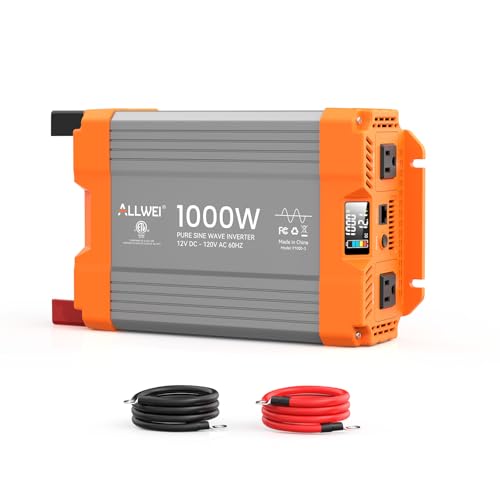
ALLWEI 1000W Pure Sine Wave Power Inverter 12V DC to 120V AC, ETL Listed to UL 458
buyers who want a documented safety listing
Our take Check price for ALLWEI 1000W Pure Sine Wave Power Inverter 12V DC to 120V AC, ETL Listed to UL 458 (opens in a new tab)

Best High-Wattage Option
TOPBULL 3000W Power Inverter Car/Home 12V DC to 110V/120V AC with 200ft Wireless Remote
large lithium banks running tools or a small AC
Our take Check price for TOPBULL 3000W Power Inverter Car/Home 12V DC to 110V/120V AC with 200ft Wireless Remote (opens in a new tab)

Cheapest 3000W
Cantonape 3000W Modified Sine Wave Power Inverter 12V to 110V/120V with LCD Display
simple loads on a tight budget
Our take Check price for Cantonape 3000W Modified Sine Wave Power Inverter 12V to 110V/120V with LCD Display (opens in a new tab)

Best for Charging Only
BESTEK 300W Pure Sine Wave Power Inverter, DC 12-17V to 110V AC
phones, laptops and camera batteries only
Our take Check price for BESTEK 300W Pure Sine Wave Power Inverter, DC 12-17V to 110V AC (opens in a new tab)
Why Each Pick Made the Cut
Best for Most RVers1 of 5
LANDERPOW 1000 Watt Pure Sine Wave Inverter, 12V DC to 120V AC, with 15ft Wired Remote on Amazon (opens in a new tab)
The strongest case for LANDERPOW 1000 Watt Pure Sine Wave Inverter, 12V DC to 120V AC, with 15ft Wired Remote is pure sine output suits CPAP machines and laptop chargers.
Best for
- most RVers running electronics and small appliances
Why it made the shortlist
For most RVers running electronics and small appliances, this is one of the more relevant configurations in the shortlist. The documented setup centers on 1000W continuous, 2000W surge, pure sine, over 91 percent, 15ft wired LED remote.
Its case starts with pure sine output suits CPAP machines and laptop chargers. At 15ft wired LED remote, this is the shortest directly comparable option. It favors easier handling and storage, but gives up reach.
The trade-off worth checking first is listing gives no warranty length or no-load draw. Measure the actual run from the hookup or outlet to where the gear will sit before choosing this length, and leave slack for uneven sites.
Key dimensions & specs
- 1000W continuous, 2000W surge
- Pure sine, over 91 percent
- 15ft wired LED remote
Pros
- Pure sine output suits CPAP machines and laptop chargers
- Remote with LED screen mounts away from the battery
- Cables supplied, so one fewer part to buy
- USB-C PD port covers phone and tablet charging
Cons
- Listing gives no warranty length or no-load draw
- Cannot run an air conditioner or microwave
Best Safety Listing2 of 5
ALLWEI 1000W Pure Sine Wave Power Inverter 12V DC to 120V AC, ETL Listed to UL 458 on Amazon (opens in a new tab)
ALLWEI 1000W Pure Sine Wave Power Inverter 12V DC to 120V AC, ETL Listed to UL 458 is the better fit when buyers who want a documented safety listing.
Best for
- buyers who want a documented safety listing
Why it made the shortlist
The intended use case is buyers who want a documented safety listing. The documented setup centers on 1000W, 2000W surge, eTL listed to UL 458, 8 protections, auto fans.
What separates it on paper is eTL listing to UL 458 is stated plainly. Against the other 4 picks, the useful comparison starts with 1000W, 2000W surge and eTL listed to UL 458. Those details show whether its configuration suits the job better than a neighboring recommendation.
Before committing, account for costs $10 more than the LANDERPOW for similar output. Confirm the exact model number and included components before ordering. Check dimensions, compatibility and maintenance needs against the way you plan to use and store it.
Key dimensions & specs
- 1000W, 2000W surge
- ETL listed to UL 458
- 8 protections, auto fans
Pros
- ETL listing to UL 458 is stated plainly
- Eight protections cover voltage, temperature and overload faults
- Fans change speed with load, so idle stays quieter
- Pure sine output is safe for sensitive devices
Cons
- Costs $10 more than the LANDERPOW for similar output
- No-load draw is described but never given in watts
Best High-Wattage Option3 of 5
TOPBULL 3000W Power Inverter Car/Home 12V DC to 110V/120V AC with 200ft Wireless Remote on Amazon (opens in a new tab)
Choose TOPBULL 3000W Power Inverter Car/Home 12V DC to 110V/120V AC with 200ft Wireless Remote for 200ft wireless remote with one-button shutdown.
Best for
- large lithium banks running tools or a small AC
Why it made the shortlist
TOPBULL 3000W Power Inverter Car/Home 12V DC to 110V/120V AC with 200ft Wireless Remote is positioned for large lithium banks running tools or a small AC. The documented setup centers on 3000W continuous, 6000W peak, two 20A outlets, USB-C 30W, 200ft wireless remote.
The feature doing most of the work here is 200ft wireless remote with one-button shutdown. At 200ft wireless remote, this is the longest directly comparable option. It favors reach, while requiring more room to drain, coil and store.
The practical constraint here is needs a big battery bank and heavy cable to deliver 3000W. Measure the actual run from the hookup or outlet to where the gear will sit before choosing this length, and leave slack for uneven sites.
Key dimensions & specs
- 3000W continuous, 6000W peak
- Two 20A outlets, USB-C 30W
- 200ft wireless remote
Pros
- 200ft wireless remote with one-button shutdown
- Two 20A outlets handle higher-draw tools
- Thick copper cables are included in the package
- Ten separate protection mechanisms are listed
Cons
- Needs a big battery bank and heavy cable to deliver 3000W
Cheapest 3000W4 of 5
Cantonape 3000W Modified Sine Wave Power Inverter 12V to 110V/120V with LCD Display on Amazon (opens in a new tab)
Cantonape 3000W Modified Sine Wave Power Inverter 12V to 110V/120V with LCD Display makes the shortlist because four AC outlets and four USB ports on one unit.
Best for
- simple loads on a tight budget
Why it made the shortlist
This model is aimed at simple loads on a tight budget. The documented setup centers on 3000W, 6000W surge, modified sine wave, 4 AC outlets, 4 USB ports.
The most useful documented advantage is four AC outlets and four USB ports on one unit. Against the other 4 picks, the useful comparison starts with 3000W, 6000W surge and modified sine wave. Those details show whether its configuration suits the job better than a neighboring recommendation.
The main limitation to plan around is modified sine output can stress motors and electronics. Confirm the exact model number and included components before ordering. Check dimensions, compatibility and maintenance needs against the way you plan to use and store it.
Key dimensions & specs
- 3000W, 6000W surge
- Modified sine wave
- 4 AC outlets, 4 USB ports
Pros
- Four AC outlets and four USB ports on one unit
- LCD shows input voltage, load and frequency
- Isolated ground neutral design is stated
- Aluminum body helps move heat away
Cons
- Modified sine output can stress motors and electronics
- Remote needs its own 23A battery, which is not included
Best for Charging Only5 of 5
BESTEK 300W Pure Sine Wave Power Inverter, DC 12-17V to 110V AC on Amazon (opens in a new tab)
The strongest case for BESTEK 300W Pure Sine Wave Power Inverter, DC 12-17V to 110V AC is only pick that lists a warranty, 18 months.
Best for
- phones, laptops and camera batteries only
Why it made the shortlist
For phones, laptops and camera batteries only, this is one of the more relevant configurations in the shortlist. The documented setup centers on 300W, 700W peak, pure sine, 11-17V input, 18-month warranty.
Its case starts with only pick that lists a warranty, 18 months. Against the other 4 picks, the useful comparison starts with 300W, 700W peak and pure sine, 11-17V input. Those details show whether its configuration suits the job better than a neighboring recommendation.
The trade-off worth checking first is 300W limit rules out microwaves, hair dryers and most appliances. Confirm whether the battery and charger are included with the exact package. Check platform compatibility and published runtime against the area or workload you need to cover.
Key dimensions & specs
- 300W, 700W peak
- Pure sine, 11-17V input
- 18-month warranty
Pros
- Only pick that lists a warranty, 18 months
- Built-in 40A fuse protects the wiring
- Small size fits a console or glovebox
Cons
- 300W limit rules out microwaves, hair dryers and most appliances
- Output is too small for most kitchen or comfort appliances
How We Built This Shortlist
Each pick was assessed across 5 criteria weighted for real-world use.
- Waveform and what it protects
- We checked whether each listing says pure or modified sine plainly, because that decides whether a CPAP, a laptop brick or a motor tool is safe to plug in.
- Real battery draw at full load
- We converted each continuous rating into estimated DC amps at 12V, adding a loss margin, to show which models demand cable and a battery bank most travelers do not have.
- Surge and boost honesty
- We separated continuous watts from peak claims and noted where a listing describes only a short boost, so a number on the box is not read as a running limit.
- Controls, remote and outlets
- We compared remotes, displays, outlet count and the 15A versus 20A sockets, since where you mount the unit often decides how usable it is.
- Safety documentation
- We looked for named standards, protections and warranty terms in the listing, and marked anything left unstated rather than guessing.
What Matters Before You Choose an RV Inverter
Key buying criteria so you get the right fit the first time.
Pure sine versus modified sine
Pure sine wave output is a smooth curve like utility power, while modified sine is a stepped approximation. Sensitive loads such as CPAP machines, laptop supplies and variable speed motors can run hot, buzz or fault on the stepped wave. Look for the words pure sine in the title or first bullet, and treat a listing that never says either as unconfirmed.
Continuous watts, not surge
Continuous watts is what the inverter can supply indefinitely, while surge is a brief peak for startup that may last only a few seconds. A 1000W unit with 2000W surge cannot run a 1500W load, even for a short while. Check that your largest running load sits under the continuous figure with about 20 percent to spare.
DC current and cable size
The inverter pulls its energy from the battery at 12V, so every 1000W of output needs roughly 83A, plus losses, from the battery. Thin cable overheats and drops voltage, which can trip a low-voltage shutdown. Match the included cable gauge to the inverter's size, and the listing's 7AWG for 1000W is a useful reference point.
Battery BMS current limit
A lithium battery's battery management system caps how many amps it can deliver, often 100A or 200A. A 3000W load needs about 250A or more, so a single 100Ah battery will shut down under it. Compare the inverter's full-load amps to the BMS continuous rating on the battery listing.
Remote, display and mounting
An inverter is usually mounted near the battery, often in a bay or cabinet where you cannot see it. A remote with a screen lets you shut it down and read voltage from inside the RV. Look for the remote cable length or wireless range, and confirm the display shows input voltage and load, not only a power light.
Documented protections and standards
Low-voltage, overload, over-temperature and reverse polarity protection prevent a mistake from becoming a fire or a dead battery. A named standard such as UL 458 is stronger evidence than a list of marketing terms. Search the listing for standards and a warranty length, and treat their absence as a question to ask the seller.
Match an RV Inverter to Your RV
By What You Plug In
Add up the watts on the plug labels of everything that runs at the same time, then add about 20 percent headroom.
| Your situation | Recommended pick | Why |
|---|---|---|
| Phones, tablets and a laptop only | BESTEK 300W | 300W covers chargers at the lowest price |
| TV, laptop, CPAP and chargers together | LANDERPOW 1000W | Pure sine, 1000W continuous, remote and cables included |
| Same load, but a listed product matters | ALLWEI 1000W | ETL listed to UL 458 |
| Corded tool or window air conditioner on a lithium bank | TOPBULL 3000W | 3000W continuous, two 20A outlets |
| Work lights and basic tools only | Cantonape 3000W | Cheapest 3000W, but modified sine |
Scroll sideways to see every column.
By Budget
| Budget | Recommended pick |
|---|---|
| Under $50 | BESTEK 300W at $41.99 |
| $99 to $110 | LANDERPOW 1000W or ALLWEI 1000W |
| $139 to $150 | Cantonape 3000W or TOPBULL 3000W |
Pure Sine vs Modified Sine
- Pure sine
- The output wave is smooth like household power, so CPAP machines, laptop supplies, newer TVs and motors run cool and quiet. The BESTEK 300W, LANDERPOW 1000W and ALLWEI 1000W state this plainly.
- Modified sine
- A stepped wave that works for resistive loads and many chargers, but can add heat, buzz or errors to sensitive devices. In this guide only the Cantonape 3000W states it.
Default to pure sine unless your loads are only lights and heaters; the price gap is small here.
By Battery Bank Size
Divide continuous watts by 12 for rough battery amps, then add 10 to 15 percent for conversion loss.
| Your battery | Recommended pick | Why |
|---|---|---|
| One 100Ah battery | LANDERPOW 1000W | About 83A to 95A at full load, within a 100A BMS |
| One 200Ah lithium with 200A BMS | ALLWEI 1000W | Leaves headroom for cable and surge |
| Small bank, charging gadgets only | BESTEK 300W | About 25A at full load |
| Large bank or 400Ah plus | TOPBULL 3000W | Roughly 250A to 290A at full load |
Scroll sideways to see every column.
For CPAP and Medical Use Specifically
- Look for
- Pure sine output, a stated protection set, and enough continuous watts for the machine plus a heated humidifier. Check the device's own power label, and never rely on a modified sine unit.
- In this comparison
- The LANDERPOW 1000W and ALLWEI 1000W are pure sine and suit a CPAP. The ALLWEI adds the ETL listing, which is a reason to pay $10 more.
When to Spend More
- Spend more if
- You run tools or a window air conditioner; the TOPBULL 3000W has two 20A outlets, but plan for cable and a large lithium bank first.
- Save if
- You only charge and watch things; the BESTEK 300W or the LANDERPOW 1000W cost under $100 and cover the load.
Before You Bring One Home
What size RV inverter do I need?
Add the running watts of everything you plan to use at once, then add about 20 percent. A laptop, TV and phone chargers usually fit under 500W, while a coffee maker or hair dryer needs 1000W or more. If you want to run an air conditioner, step up to a 3000W class unit with a large lithium bank.
Can I plug an RV inverter directly into the battery with the included cables?
Yes for small units, but add a fuse close to the positive terminal sized to the cable and inverter. Keep cables short and tight, and check the manufacturer's instructions for torque. A loose connection is the most common cause of heat and voltage drop.
Is a 3000W inverter worth it over a 1000W model?
Only if you actually need the extra output. The TOPBULL 3000W costs $50 more than the LANDERPOW 1000W and demands roughly three times the battery current. Most travelers who only run electronics are better served by the 1000W pure sine units.
How do I connect an inverter to my RV outlets?
Plug-in inverters power only the outlets on the unit itself. Powering the RV's wall outlets needs a hardwire connection with a transfer switch to avoid backfeeding shore power or a generator, which is a job for a qualified installer.
Does an inverter drain the battery when nothing is plugged in?
Yes, a small amount. Every inverter has a no-load draw that varies by model and is often not listed. Turn the unit off with the remote when you are not using it, especially when running from a small battery.
Do I need a pure sine wave inverter for a CPAP?
Most CPAP makers recommend pure sine, and a modified sine wave can cause noise or faults. Check your machine's manual, and use a pure sine unit like the LANDERPOW 1000W or ALLWEI 1000W with enough watts for a heated humidifier.
Bottom Line
Best overall: LANDERPOW 1000 Watt Pure Sine Wave Inverter, 12V DC to 120V AC, with 15ft Wired Remote — best for most rvers pick in this roundup. See the full verdicts above for every pick, with pros, cons and who each one suits.
Browse all rv inverters on Amazon — Prime-eligible options with current pricing.