
Buying Guide
6 Best 100Ah Lithium RV Batteries in 2026: A Practical RV Guide
Six 12V 100Ah LiFePO4 RV batteries compared on 1,280Wh cost, Group 24 vs Group 31 fit, cold limits, Bluetooth and warranty, from $143 to $220.
By Hardcastle's RV Editors
10 min read6 products evaluated
A 12.8V 100Ah lithium battery stores 1,280 watt-hours on the label, and that single number is where most 100Ah comparisons stop. For an RV the more useful questions are physical and electrical: will it drop into a Group 24 or Group 31 tray, how much current can the battery protection circuit pass, at what temperature does it refuse to charge, and can you read its charge level without a separate monitor. Those answers differ more than the capacity does.
We compared six 12V 100Ah LiFePO4 batteries priced from $142.99 to $219.99 on cost per nominal kilowatt-hour, case size class, published temperature limits, monitoring and warranty. The whole field costs between about $112 and $172 per kWh, so a spread of $77 between cheapest and dearest comes down to size, app and documentation rather than energy. One 100Ah battery is also the natural building block for larger banks, so we noted how each one expands.
Hardcastle’s RV field notes
The Rig Fit Check
A quick way to connect the shortlist to the space, workload and ownership details that matter after the box arrives.
- Start with the job
- Dyness 12V 100Ah LiFePO4 Lithium Battery for RV, Solar System and Off-Grid (Group 31) leads this shortlist for Group 31 swaps that want published cold limits. Use that fit as a reference point, then compare the alternatives against your own space and workload.
- Specs that separate the picks
- The first details to compare are Group 31, 21.8 lb, Group 24 mini, Bluetooth, 46 percent smaller than Group 31. Confirm the exact model and included components before ordering.
- Trade-off to plan for
- No Bluetooth, so charge level needs a separate monitor
The Practical Shortlist
A road-tested-thinking look at 6 options, organized around the job each one suits best.
Best Overall
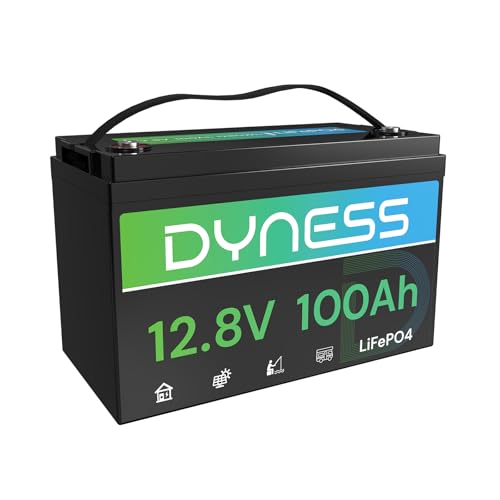
Dyness 12V 100Ah LiFePO4 Lithium Battery for RV, Solar System and Off-Grid (Group 31)
Group 31 swaps that want published cold limits
Our take Check price for Dyness 12V 100Ah LiFePO4 Lithium Battery for RV, Solar System and Off-Grid (Group 31) (opens in a new tab)

Best Mini With Bluetooth
Wattcycle 12V 100Ah Mini LiFePO4 Battery Group 24 with 100A BMS Bluetooth
tight Group 24 bays that want an app
Our take Check price for Wattcycle 12V 100Ah Mini LiFePO4 Battery Group 24 with 100A BMS Bluetooth (opens in a new tab)
Smallest Case
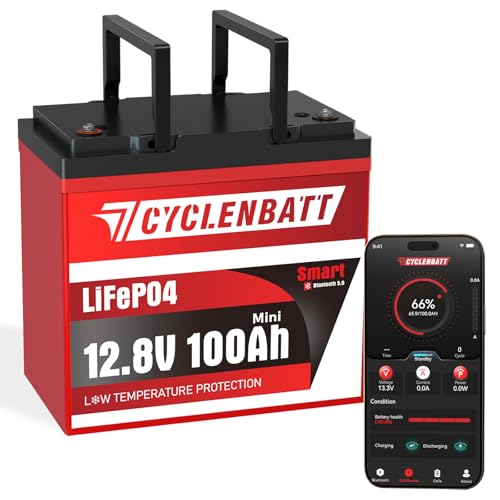
CYCLENBATT 12V 100Ah Mini Bluetooth LiFePO4 Battery, Low-Temp Protection
vans and tight compartments needing the smallest case
Our take Check price for CYCLENBATT 12V 100Ah Mini Bluetooth LiFePO4 Battery, Low-Temp Protection (opens in a new tab)
Best Built-In Meter
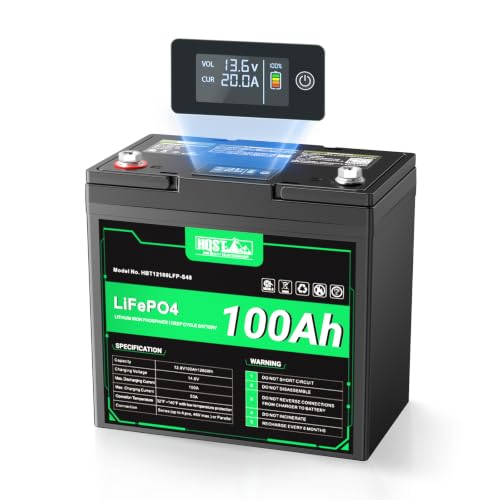
HQST 12V 100Ah LiFePO4 Battery, Group 22NF Mini, BMS, LED Meter, 1280Wh
indoor-stored rigs that want a simple on-case meter
Our take Check price for HQST 12V 100Ah LiFePO4 Battery, Group 22NF Mini, BMS, LED Meter, 1280Wh (opens in a new tab)
Best Budget Bluetooth
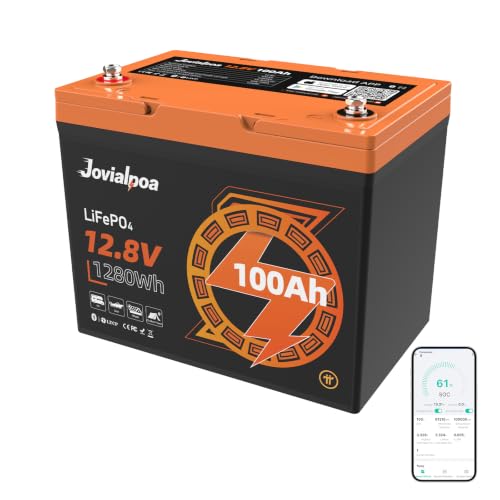
Jovialpoa 12V 100Ah LiFePO4 RV Battery with Bluetooth App, IP65, 100A BMS
budget buyers wanting Bluetooth and a sealed case
Our take Check price for Jovialpoa 12V 100Ah LiFePO4 RV Battery with Bluetooth App, IP65, 100A BMS (opens in a new tab)

Lowest Price
BUKNUWO 12V 100Ah LiFePO4 Lithium Battery with Bluetooth
buyers comparing capacity, compatibility, included components and storage needs
Our take Check price for BUKNUWO 12V 100Ah LiFePO4 Lithium Battery with Bluetooth (opens in a new tab)
Why Each Pick Made the Cut
Best Overall1 of 6
Dyness 12V 100Ah LiFePO4 Lithium Battery for RV, Solar System and Off-Grid (Group 31) on Amazon (opens in a new tab)
The strongest case for Dyness 12V 100Ah LiFePO4 Lithium Battery for RV, Solar System and Off-Grid (Group 31) is charge cutoff at 32°F and restart at 41°F both published.
Best for
- Group 31 swaps that want published cold limits
Why it made the shortlist
For Group 31 swaps that want published cold limits, this is one of the more relevant configurations in the shortlist. The documented setup centers on group 31, 21.8 lb, iP65 with salt-spray resistance, charge stops below 32°F.
Its case starts with charge cutoff at 32°F and restart at 41°F both published. Its Group 31, 21.8 lb specification sits at between the lower and upper ends of the comparable range in this 3-product comparison. Confirm whether that figure refers to tool weight or working capacity before comparing it directly.
The trade-off worth checking first is no Bluetooth, so charge level needs a separate monitor. Confirm whether the stated figure refers to product weight or rated working capacity. Compare it with your lifting, transport and support requirements before deciding.
Key dimensions & specs
- Group 31, 21.8 lb
- IP65 with salt-spray resistance
- Charge stops below 32°F
Pros
- Charge cutoff at 32°F and restart at 41°F both published
- IP65 case suits an exposed or damp battery bay
- Standard Group 31 size drops into most existing trays
- Expands to 20.48kWh with identical units
Cons
- No Bluetooth, so charge level needs a separate monitor
- Group 31 is bigger than the Mini batteries here
Best Mini With Bluetooth2 of 6
Wattcycle 12V 100Ah Mini LiFePO4 Battery Group 24 with 100A BMS Bluetooth on Amazon (opens in a new tab)
Wattcycle 12V 100Ah Mini LiFePO4 Battery Group 24 with 100A BMS Bluetooth is the better fit when tight Group 24 bays that want an app.
Best for
- tight Group 24 bays that want an app
Why it made the shortlist
The intended use case is tight Group 24 bays that want an app. The documented setup centers on group 24 mini, Bluetooth, 100A BMS, five-year warranty, expands to 20.48kWh.
What separates it on paper is group 24 case is 39 percent smaller than first generation. Against the other 5 picks, the useful comparison starts with group 24 mini, Bluetooth and 100A BMS, five-year warranty. Those details show whether its configuration suits the job better than a neighboring recommendation.
Before committing, account for exact charge cutoff temperature is not published. Confirm the exact model number and included components before ordering. Check dimensions, compatibility and maintenance needs against the way you plan to use and store it.
Key dimensions & specs
- Group 24 mini, Bluetooth
- 100A BMS, five-year warranty
- Expands to 20.48kWh
Pros
- Group 24 case is 39 percent smaller than first generation
- Bluetooth app shows voltage and current without extra hardware
- Operates down to minus 4°F with low-temperature shutoff
Cons
- Exact charge cutoff temperature is not published
Smallest Case3 of 6
CYCLENBATT 12V 100Ah Mini Bluetooth LiFePO4 Battery, Low-Temp Protection on Amazon (opens in a new tab)
Choose CYCLENBATT 12V 100Ah Mini Bluetooth LiFePO4 Battery, Low-Temp Protection for app can switch charging and discharging off remotely.
Best for
- vans and tight compartments needing the smallest case
Why it made the shortlist
CYCLENBATT 12V 100Ah Mini Bluetooth LiFePO4 Battery, Low-Temp Protection is positioned for vans and tight compartments needing the smallest case. The documented setup centers on 46 percent smaller than Group 31, bluetooth 5.0 app with remote switch, 330A instantaneous discharge.
The feature doing most of the work here is app can switch charging and discharging off remotely. Against the other 5 picks, the useful comparison starts with 46 percent smaller than Group 31 and bluetooth 5.0 app with remote switch. Those details show whether its configuration suits the job better than a neighboring recommendation.
The practical constraint here is costs $23 more than the Dyness with no heater. Confirm the exact model number and included components before ordering. Check dimensions, compatibility and maintenance needs against the way you plan to use and store it.
Key dimensions & specs
- 46 percent smaller than Group 31
- Bluetooth 5.0 app with remote switch
- 330A instantaneous discharge
Pros
- App can switch charging and discharging off remotely
- Charge cutoff at 32°F and discharge cutoff at minus 4°F stated
- Handles 330A surge for compressor or inverter startup
Cons
- Costs $23 more than the Dyness with no heater
Best Built-In Meter4 of 6
HQST 12V 100Ah LiFePO4 Battery, Group 22NF Mini, BMS, LED Meter, 1280Wh on Amazon (opens in a new tab)
HQST 12V 100Ah LiFePO4 Battery, Group 22NF Mini, BMS, LED Meter, 1280Wh makes the shortlist because lED meter shows charge without opening an app.
Best for
- indoor-stored rigs that want a simple on-case meter
Why it made the shortlist
This model is aimed at indoor-stored rigs that want a simple on-case meter. The documented setup centers on group 22NF, 21 lb, lED charge meter on case, 100A continuous discharge.
The most useful documented advantage is lED meter shows charge without opening an app. Its Group 22NF, 21 lb specification sits at the lower end of the comparable range in this 3-product comparison. Confirm whether that figure refers to tool weight or working capacity before comparing it directly.
The main limitation to plan around is no Bluetooth for logging current or temperature. Confirm whether the stated figure refers to product weight or rated working capacity. Compare it with your lifting, transport and support requirements before deciding.
Key dimensions & specs
- Group 22NF, 21 lb
- LED charge meter on case
- 100A continuous discharge
Pros
- LED meter shows charge without opening an app
- Charge and discharge limits are published for both hot and cold
- 21 pounds, about 65 percent lighter than lead-acid
Cons
- No Bluetooth for logging current or temperature
Best Budget Bluetooth5 of 6
Jovialpoa 12V 100Ah LiFePO4 RV Battery with Bluetooth App, IP65, 100A BMS on Amazon (opens in a new tab)
The strongest case for Jovialpoa 12V 100Ah LiFePO4 RV Battery with Bluetooth App, IP65, 100A BMS is bluetooth and IP65 case together at $150.
Best for
- budget buyers wanting Bluetooth and a sealed case
Why it made the shortlist
For budget buyers wanting Bluetooth and a sealed case, this is one of the more relevant configurations in the shortlist. The documented setup centers on bluetooth with 100A BMS, iP65 flame-retardant case, three-year warranty.
Its case starts with bluetooth and IP65 case together at $150. Against the other 5 picks, the useful comparison starts with bluetooth with 100A BMS and iP65 flame-retardant case. Those details show whether its configuration suits the job better than a neighboring recommendation.
The trade-off worth checking first is charge cutoff temperature is not stated in the listing. Confirm the exact model number and included components before ordering. Check dimensions, compatibility and maintenance needs against the way you plan to use and store it.
Key dimensions & specs
- Bluetooth with 100A BMS
- IP65 flame-retardant case
- Three-year warranty
Pros
- Bluetooth and IP65 case together at $150
- 20,000 cycles claimed at 60 percent depth of discharge
- Recharges in about five hours with a 20A charger
- M8 terminals and carry handle ease installation
Cons
- Charge cutoff temperature is not stated in the listing
- Standard warranty is three years, shorter than rivals
Lowest Price6 of 6
BUKNUWO 12V 100Ah LiFePO4 Lithium Battery with Bluetooth on Amazon (opens in a new tab)
BUKNUWO 12V 100Ah LiFePO4 Lithium Battery with Bluetooth is the better fit when buyers comparing capacity, compatibility, included components and storage needs.
Best for
- buyers comparing capacity, compatibility, included components and storage needs
Why it made the shortlist
The intended use case is buyers comparing capacity, compatibility, included components and storage needs. The documented setup centers on bluetooth 5.0, 100A BMS, 22 lb, 1.28kWh, five-year warranty.
What separates it on paper is bluetooth shows temperature along with charge and current. Its 22 lb, 1.28kWh specification sits at the upper end of the comparable range in this 3-product comparison. Confirm whether that figure refers to tool weight or working capacity before comparing it directly.
Before committing, account for charge cutoff temperature is not stated in the listing. Confirm whether the stated figure refers to product weight or rated working capacity. Compare it with your lifting, transport and support requirements before deciding.
Key dimensions & specs
- Bluetooth 5.0, 100A BMS
- 22 lb, 1.28kWh
- Five-year warranty
Pros
- Bluetooth shows temperature along with charge and current
- Self-discharge under 5 percent a month for storage
Cons
- Charge cutoff temperature is not stated in the listing
How We Built This Shortlist
Each pick was assessed across 5 criteria weighted for real-world use.
- Cost per nominal kilowatt-hour
- We divided each price by 1.28kWh and compared the result, then checked whether the cycle claim was stated at 100, 80 or 60 percent depth of discharge.
- Case size class and weight
- We separated Group 31, Group 24 and Group 22NF cases, since a 100Ah battery that does not fit the existing tray costs extra to mount.
- Published temperature limits
- We looked for exact charge and discharge cutoffs in degrees, and marked listings that only say low-temperature protection.
- Monitoring and control
- We checked for Bluetooth, an on-case meter or a remote switch, because a 100Ah battery has no other way to show its charge.
- Enclosure and warranty
- We compared IP ratings, terminal type and warranty length, treating a vague case description as less documented than a stated IP65.
What Matters Before You Choose a 100Ah Lithium RV Battery
Key buying criteria so you get the right fit the first time.
Nominal versus usable energy
A 12.8V 100Ah battery stores 1,280 watt-hours nominally, which is the number every listing prints. What you can use depends on the cutoff voltage, the discharge rate and inverter losses, so a 1,000W microwave pulling from it will not deliver the full 1,280Wh. Divide price by 1.28 to compare cost per kilowatt-hour, and read whether the cycle claim is at 100, 80 or 60 percent depth of discharge.
Group 24, Group 31 and Group 22NF fit
These BCI group names describe a standard case footprint, and lithium makers use them loosely. A Group 31 is about 13 by 6.8 by 8.4 inches, while a mini Group 24 is about 10.2 by 6.6 by 8.2 inches, and the wrong size leaves a loose battery that needs a new tray. Measure the tray in length, width and height, then compare against the dimensions printed on the product page, not the group name.
BMS continuous and surge amps
The battery management system limits the current the battery can deliver. A 100A BMS at 12.8V supports about 1,280 watts, which is plenty for lights, pump and fridge but too little for a 2,000W inverter at full load. Look for the continuous amp rating in the bullet points, and note that the surge number, such as 330A for CYCLENBATT, only lasts a moment.
Exact cold-weather cutoffs
Lithium iron phosphate cells can be damaged by charging below freezing, so a good battery management system blocks charging at a set temperature. Some listings give both thresholds, such as Dyness stopping at 32°F and restarting at 41°F, and others only say low-temperature protection. Prefer the listing with numbers, and email the seller if it only uses the phrase.
Monitoring you can actually read
A 100Ah battery has no fuel gauge unless the maker adds one. Bluetooth apps show voltage, current and temperature, an LED meter shows rough charge, and the least expensive option is a standalone shunt. Check that the app exists for your phone type and note that Bluetooth range is short, so it cannot replace a monitor mounted in the cabin.
Series and parallel limits
A single 100Ah battery is often the first of several, so the expansion limit matters on day one. Most listings here allow 4S4P for 20.48kWh, and expanding with a different model or age can unbalance the bank. Buy identical units, and confirm the warranty still applies to a multi-battery bank.
Match a 100Ah Lithium RV Battery to Your RV
By Battery Tray Size
| Your situation | Recommended pick | Why |
|---|---|---|
| Replacing a Group 31 lead-acid battery | Dyness G31 100Ah | Standard Group 31 case at 13.00 by 6.77 by 8.43 inches |
| Group 24 tray or under-bench box | Wattcycle Mini 100Ah | Group 24 mini with Bluetooth |
| Smallest possible space in a van or camper | CYCLENBATT Mini | Listed as 46 percent smaller than Group 31 |
| Tray built for Group 22NF | HQST 22NF | Group 22NF mini with built-in LED meter |
| Open mounting space with no strict size | BUKNUWO 100Ah | Cheapest at $142.99, 22 lb |
Scroll sideways to see every column.
By Budget
| Budget | Recommended pick |
|---|---|
| Under $150 | BUKNUWO 100Ah ($142.99) or Jovialpoa 100Ah ($150) |
| $150 to $180 | HQST 22NF ($159.99) or Dyness G31 100Ah ($176.98) |
| $180 to $200 | CYCLENBATT Mini ($199.99) |
| Over $200 | Wattcycle Mini 100Ah ($219.99) |
App Monitoring vs On-Case Meter
- App monitoring
- Bluetooth shows voltage, current and temperature on your phone and sometimes lets you switch the battery off remotely. Wattcycle Mini, CYCLENBATT Mini, Jovialpoa and BUKNUWO include it, and the app range is short, so you must be near the battery.
- On-case meter
- An LED meter gives a rough charge reading at a glance and needs no phone, but shows no current or history. In this comparison only the HQST 22NF has one, and the Dyness G31 has neither an app nor a meter.
Most owners are better served by Bluetooth, since a 100Ah battery has no other way to report current draw.
By Cold Weather Exposure
| Where it will sit | Recommended pick |
|---|---|
| Exposed bay with published cutoffs needed | Dyness G31 100Ah (stops charging below 32°F, restarts at 41°F) |
| Heated or interior cabinet, app wanted | Wattcycle Mini 100Ah or CYCLENBATT Mini |
| Indoor storage, mild winters only | HQST 22NF (charge suspended below 23°F) |
| Dry, mild site, lowest cost | BUKNUWO 100Ah or Jovialpoa 100Ah |
For Building a Bigger Bank Specifically
- Look for
- Matching 100Ah units from one maker, a stated maximum series or parallel count and a BMS rated at least 100A. Four 100Ah batteries wired in parallel give 400Ah at 12V, and four in series give 51.2V, so confirm the listing allows both before you buy a first unit.
- In this comparison
- The Dyness G31, Wattcycle Mini, CYCLENBATT Mini, Jovialpoa and BUKNUWO all state 4S4P expansion up to 20.48kWh. HQST states up to 16 units in series and parallel. Buy the same model each time, since mixing brands is not endorsed.
When to Spend More
- Spend more if
- You need the tightest fit or documented limits. Wattcycle Mini and CYCLENBATT Mini add small Bluetooth cases, while Dyness G31 adds IP65 and exact cold cutoffs for $176.98.
- Save if
- The battery lives indoors in mild weather. BUKNUWO at $142.99 and Jovialpoa at $150 each include Bluetooth, and Jovialpoa adds an IP65 case.
Before You Bring One Home
Is a 100Ah lithium battery enough for an RV?
For a weekend with lights, a water pump, a fan and a phone charger, yes. A 1,280Wh battery at an average 60W load runs roughly 21 hours before inverter losses. Add a microwave, TV or air conditioner and you will want 200Ah or more, so see our 200Ah guide.
Will my converter charge a 100Ah lithium battery correctly?
Many older converters use a lead-acid profile that can undercharge lithium. Look for a lithium mode, or a charger that outputs about 14.6 volts. Our converter guides list lithium-ready models.
Is the Group 31 or the Group 24 battery better?
Group 24 is smaller and fits tight trays, while Group 31 has more room and is the common standard in travel trailers. Neither is more powerful at 100Ah, so choose by what fits your tray.
How do I connect two 100Ah batteries for 200Ah?
Wire them in parallel: positive to positive and negative to negative, using equal-length cables so the load shares evenly. Use two matching batteries, charge them together, and keep a fuse on the main positive lead.
Do I need a battery monitor on a 100Ah battery?
Not if it has Bluetooth, but a shunt gives a more accurate state of charge, and it works across the whole bank if you add more batteries later. Without any monitor you can only watch voltage, which stays flat across most of the lithium discharge curve.
Can I leave a lithium battery connected over winter?
Disconnect it from loads and store it around 50 to 80 percent charge, in a space that stays above the charge cutoff temperature if possible. Check the voltage every month or two, since the monitor and BMS draw a small standby current.
Bottom Line
Best overall: Dyness 12V 100Ah LiFePO4 Lithium Battery for RV, Solar System and Off-Grid (Group 31) — best overall pick in this roundup. See the full verdicts above for every pick, with pros, cons and who each one suits.
Browse all 100ah lithium rv batteries on Amazon — Prime-eligible options with current pricing.