
Buying Guide
5 Best 12V to 120V Inverters for RVs in 2026: A Practical RV Guide
Five 12V to 120V RV inverters from 600W to 3000W compared on DC amps drawn, cable needs, charger and transfer features, and price, from $70 to $655.
By Hardcastle's RV Editors
10 min read5 products evaluated
A 12 volt battery system is the default in most RVs, and it sets a hard ceiling on how big an inverter makes sense. Power is volts times amps, so every watt you pull at 120V AC has to be fed by roughly ten times as many amps at 12V DC, plus the energy lost in conversion. A 3000W inverter at full load asks a 12V battery bank for around 250 amps before losses, which is more than most single batteries, cables and fuses are built to carry.
We compared five 12V input inverters from 600W to 3000W, priced from $70 to $655, on the DC current each would draw at its rated load, what the listing says about cables, charging and transfer switching, and how well the rating fits a 12V bank. The point of this guide is the 12V boundary: which sizes are comfortable, which are stretching it, and what extra hardware the bigger ones quietly require.
Hardcastle’s RV field notes
The Rig Fit Check
A quick way to connect the shortlist to the space, workload and ownership details that matter after the box arrives.
- Start with the job
- Renogy 2000W Pure Sine Wave Inverter Charger, 12V DC to 120V AC, 6000W Surge leads this shortlist for owners wanting inverter and charger in one 12V unit. Use that fit as a reference point, then compare the alternatives against your own space and workload.
- Specs that separate the picks
- The first details to compare are 2000W, 6000W surge, 1200W pure sine, 3000W, 6000W peak. Confirm the exact model and included components before ordering.
- Trade-off to plan for
- Costs about four times the Ampinvt or HONOURLIGHT
The Practical Shortlist
A road-tested-thinking look at 5 options, organized around the job each one suits best.

Best Overall for 12V
Renogy 2000W Pure Sine Wave Inverter Charger, 12V DC to 120V AC, 6000W Surge
owners wanting inverter and charger in one 12V unit
Our take Check price for Renogy 2000W Pure Sine Wave Inverter Charger, 12V DC to 120V AC, 6000W Surge (opens in a new tab)

Best Budget Inverter Charger
Ampinvt 1200W Pure Sine Wave Inverter with AC Charger, 12V DC to 120V AC
small rigs wanting charging and shore transfer cheaply
Our take Check price for Ampinvt 1200W Pure Sine Wave Inverter with AC Charger, 12V DC to 120V AC (opens in a new tab)
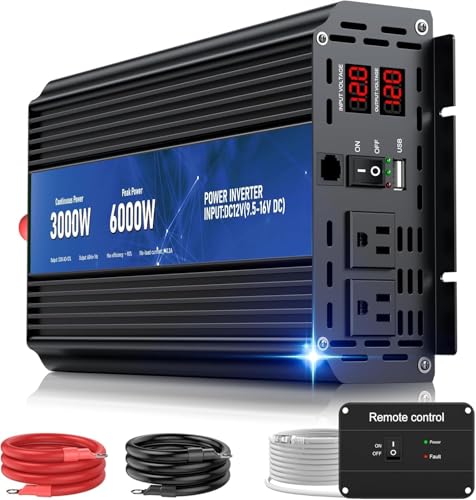
Most Power, With Caveats
HONOURLIGHT 3000W Power Inverter, 12V DC to 120V AC, 6000W Peak
large 12V lithium banks with heavy cable runs
Our take Check price for HONOURLIGHT 3000W Power Inverter, 12V DC to 120V AC, 6000W Peak (opens in a new tab)

Best Low-Cost Mid Size
OLTEANP 1000W Power Inverter, 12V DC to 120V AC, 2000W Peak
light loads on a budget in a 12V rig
Our take Check price for OLTEANP 1000W Power Inverter, 12V DC to 120V AC, 2000W Peak (opens in a new tab)

Best Entry Pure Sine
OLTEANP 600W Pure Sine Wave Inverter, 12V DC to 120V AC, 1200W Peak
CPAP, laptops and phone charging only
Our take Check price for OLTEANP 600W Pure Sine Wave Inverter, 12V DC to 120V AC, 1200W Peak (opens in a new tab)
Why Each Pick Made the Cut
Best Overall for 12V1 of 5
Renogy 2000W Pure Sine Wave Inverter Charger, 12V DC to 120V AC, 6000W Surge on Amazon (opens in a new tab)
The strongest case for Renogy 2000W Pure Sine Wave Inverter Charger, 12V DC to 120V AC, 6000W Surge is charges the battery bank, so no separate converter needed.
Best for
- owners wanting inverter and charger in one 12V unit
Why it made the shortlist
For owners wanting inverter and charger in one 12V unit, this is one of the more relevant configurations in the shortlist. The documented setup centers on 2000W, 6000W surge, four-stage charger, gel, AGM, lithium ready.
Its case starts with charges the battery bank, so no separate converter needed. Against the other 4 picks, the useful comparison starts with 2000W, 6000W surge and four-stage charger. Those details show whether its configuration suits the job better than a neighboring recommendation.
The trade-off worth checking first is costs about four times the Ampinvt or HONOURLIGHT. Confirm the exact model number and included components before ordering. Check dimensions, compatibility and maintenance needs against the way you plan to use and store it.
Key dimensions & specs
- 2000W, 6000W surge
- Four-stage charger
- Gel, AGM, lithium ready
Pros
- Charges the battery bank, so no separate converter needed
- Works with AGM, gel, flooded and lithium chemistries
- Full load needs about 185 amps, manageable for 12V
- Pure sine output suits motors and sensitive electronics
Cons
- Costs about four times the Ampinvt or HONOURLIGHT
- Listing excerpt gives no idle draw or transfer time
Best Budget Inverter Charger2 of 5
Ampinvt 1200W Pure Sine Wave Inverter with AC Charger, 12V DC to 120V AC on Amazon (opens in a new tab)
Ampinvt 1200W Pure Sine Wave Inverter with AC Charger, 12V DC to 120V AC is the better fit when small rigs wanting charging and shore transfer cheaply.
Best for
- small rigs wanting charging and shore transfer cheaply
Why it made the shortlist
The intended use case is small rigs wanting charging and shore transfer cheaply. The documented setup centers on 1200W pure sine, 0 to 15A charger, built-in transfer switch.
What separates it on paper is charge current adjustable from 0 to 15 amps. Against the other 4 picks, the useful comparison starts with 1200W pure sine and 0 to 15A charger. Those details show whether its configuration suits the job better than a neighboring recommendation.
Before committing, account for maximum 1200W rules out microwaves and air conditioners. Confirm the exact model number and included components before ordering. Check dimensions, compatibility and maintenance needs against the way you plan to use and store it.
Key dimensions & specs
- 1200W pure sine
- 0 to 15A charger
- Built-in transfer switch
Pros
- Charge current adjustable from 0 to 15 amps
- Five working modes, including generator and ECO
- Full load draws near 111 amps, easy on 12V
- Includes automatic AC transfer switch at $165
Cons
- Maximum 1200W rules out microwaves and air conditioners
- 15A charger is slow for large lithium banks
Most Power, With Caveats3 of 5
HONOURLIGHT 3000W Power Inverter, 12V DC to 120V AC, 6000W Peak on Amazon (opens in a new tab)
Choose HONOURLIGHT 3000W Power Inverter, 12V DC to 120V AC, 6000W Peak for uL and CSA certification is stated in the listing.
Best for
- large 12V lithium banks with heavy cable runs
Why it made the shortlist
HONOURLIGHT 3000W Power Inverter, 12V DC to 120V AC, 6000W Peak is positioned for large 12V lithium banks with heavy cable runs. The documented setup centers on 3000W, 6000W peak, uL and CSA listed, 14.8 ft wired remote.
The feature doing most of the work here is uL and CSA certification is stated in the listing. Against the other 4 picks, the useful comparison starts with 3000W, 6000W peak and uL and CSA listed. Those details show whether its configuration suits the job better than a neighboring recommendation.
The practical constraint here is full load needs roughly 280 DC amps on 12V. Measure the actual run from the hookup or outlet to where the gear will sit before choosing this length, and leave slack for uneven sites.
Key dimensions & specs
- 3000W, 6000W peak
- UL and CSA listed
- 14.8 ft wired remote
Pros
- UL and CSA certification is stated in the listing
- Wired remote reaches 14.8 feet from the unit
- Supports 3000W loads for tools and larger appliances
- LCD shows voltage and protection codes at a glance
Cons
- Full load needs roughly 280 DC amps on 12V
- Supplied 5 AWG cables are short and light for that load
Best Low-Cost Mid Size4 of 5
OLTEANP 1000W Power Inverter, 12V DC to 120V AC, 2000W Peak on Amazon (opens in a new tab)
OLTEANP 1000W Power Inverter, 12V DC to 120V AC, 2000W Peak makes the shortlist because full load draws about 93 amps, easy on 12V.
Best for
- light loads on a budget in a 12V rig
Why it made the shortlist
This model is aimed at light loads on a budget in a 12V rig. The documented setup centers on 1000W, 2000W peak, 36W USB-C port, two AC outlets.
The most useful documented advantage is full load draws about 93 amps, easy on 12V. Against the other 4 picks, the useful comparison starts with 1000W, 2000W peak and 36W USB-C port. Those details show whether its configuration suits the job better than a neighboring recommendation.
The main limitation to plan around is waveform type is not stated in the listing excerpt. Confirm the exact model number and included components before ordering. Check dimensions, compatibility and maintenance needs against the way you plan to use and store it.
Key dimensions & specs
- 1000W, 2000W peak
- 36W USB-C port
- Two AC outlets
Pros
- Full load draws about 93 amps, easy on 12V
- Includes 36W USB-C and a fast USB port
- LCD shows protection codes such as overload and low voltage
Cons
- Waveform type is not stated in the listing excerpt
- No charger, transfer switch or hardwire terminal
Best Entry Pure Sine5 of 5
OLTEANP 600W Pure Sine Wave Inverter, 12V DC to 120V AC, 1200W Peak on Amazon (opens in a new tab)
The strongest case for OLTEANP 600W Pure Sine Wave Inverter, 12V DC to 120V AC, 1200W Peak is pure sine output is stated for sensitive electronics.
Best for
- CPAP, laptops and phone charging only
Why it made the shortlist
For CPAP, laptops and phone charging only, this is one of the more relevant configurations in the shortlist. The documented setup centers on 600W pure sine, two AC, two USB, direct 12V connection.
Its case starts with pure sine output is stated for sensitive electronics. Against the other 4 picks, the useful comparison starts with 600W pure sine and two AC, two USB. Those details show whether its configuration suits the job better than a neighboring recommendation.
The trade-off worth checking first is 600W will not run coffee makers or hair dryers. Confirm whether the battery and charger are included with the exact package. Check platform compatibility and published runtime against the area or workload you need to cover.
Key dimensions & specs
- 600W pure sine
- Two AC, two USB
- Direct 12V connection
Pros
- Pure sine output is stated for sensitive electronics
- Full load draws only about 55 amps
- Costs $69.99 with an LCD and fault codes
- Works with a standard 12V RV battery directly
Cons
- 600W will not run coffee makers or hair dryers
- No charger, hardwire terminal or transfer switch
How We Built This Shortlist
Each pick was assessed across 5 criteria weighted for real-world use.
- DC amps at full load
- We divided each rated wattage by 12 volts, then allowed for the roughly 90 percent efficiency in the listings, to estimate the current the battery and cables must carry.
- 12V sizing fit
- We judged whether each rating sits inside what a single 12V bank can feed, and flagged sizes that need multiple batteries or heavier cable.
- Charger and transfer features
- We checked whether the unit charges the bank, switches to shore power automatically, and lets you set charge current.
- Waveform and protections
- We noted pure sine versus unstated waveforms and the listed protections against low voltage, overload, overheating and short circuit.
- Price per usable watt
- We compared price against realistic usable output, treating peak ratings as short-lived and not as capacity.
What Matters Before You Choose a 12V to 120V Inverters for RVs
Key buying criteria so you get the right fit the first time.
DC amps at your real load
Inverter current on the 12V side equals AC watts divided by 12, then divided again by efficiency, so a 1000W load pulls about 93 amps and a 2000W load about 185. Cables, fuses and battery management systems all have current limits, and exceeding any of them causes voltage drop, heat or a sudden shutdown. Check the listing for the DC input range and compare your battery management system's continuous amps rating.
Continuous versus peak watts
Continuous watts are what the inverter can sustain for hours, while peak or surge watts last for only a second or two to start motors. A unit sold as 3000W with 6000W peak may only be practical to about 2000W on a 12V system because of battery and cable limits. Look for the continuous number first and treat the peak figure as a bonus.
Pure sine versus unstated waveform
Pure sine output matches household power and runs motors, CPAP machines and chargers cleanly, while modified sine can cause buzzing and heat in some loads. Some budget listings never state the waveform, which is a warning sign. Look for the words pure sine wave in the title or the first bullet of the listing.
Charger and transfer switch
An inverter charger refills the battery from shore power or a generator, and an automatic transfer switch moves your outlets between the two sources. Without one, you need a separate converter and may have to unplug things when you plug into the pedestal. Check for a charge current in amps, the battery types it supports, and a stated transfer time.
Cable and fuse requirements
Higher DC current needs thicker cable and a properly rated fuse close to the battery, and undersized cable drops voltage so the inverter shuts down early. A short supplied cable pair, like the 2.6 foot 5 AWG set with the 3000W unit, is a starting point, not a final install. Confirm the recommended cable gauge and fuse size in the manual, not the marketing bullets.
Low-voltage cutoff and idle draw
The low-voltage cutoff protects the battery from over-discharge, while idle draw is the power the inverter uses with nothing plugged in, which drains a bank over a few days. A few watts of idle draw adds up to a surprising number of amp-hours over a week. Look for a no-load current figure in the specs, and an alarm or cutoff voltage; if the listing omits both, ask the seller.
Match a 12V to 120V Inverters for RVs to Your RV
By Your Largest Appliance
Your biggest single load, not the sum of everything, sets the minimum inverter size.
| Your situation | Recommended pick | Why |
|---|---|---|
| CPAP, laptop, TV and phone charging only | OLTEANP 600W | Pure sine output at about 55 amps full load |
| Coffee maker or small kettle up to 1000W | OLTEANP 1000W | Covers 1000W at $69.99, draws about 93 amps |
| Mix of loads plus shore power transfer | Ampinvt 1200W | Adds a charger and transfer switch for $165 |
| Microwave or induction cooktop near 1500W to 2000W | Renogy 2000W | Inverter charger rated 2000W, about 185 amps |
| Brief loads of 2000W to 3000W with a big bank | HONOURLIGHT 3000W | Highest rating, needs heavy cable and many batteries |
Scroll sideways to see every column.
By Budget
| Budget | Recommended pick |
|---|---|
| Under $75 | OLTEANP 600W for pure sine, OLTEANP 1000W for more power |
| $165 to $170 | Ampinvt 1200W with charger, or HONOURLIGHT 3000W for raw power |
| Around $655 | Renogy 2000W inverter charger |
Inverter Only vs Inverter Charger
- Inverter only
- It converts battery DC to AC and nothing else, so you still need a separate converter or charger to refill the bank. The OLTEANP 600W, OLTEANP 1000W and HONOURLIGHT 3000W are this type, and they cost far less.
- Inverter charger
- It adds a battery charger and, usually, an automatic switch that passes shore power through. The Renogy 2000W and Ampinvt 1200W are this type, and they replace the separate converter and make shore transfers seamless.
If your RV already has a working lithium-compatible converter, an inverter-only unit is fine; otherwise the Ampinvt 1200W or Renogy 2000W saves a second box.
By Battery Bank Size
| Your battery bank | Recommended pick | Why |
|---|---|---|
| One 100Ah 12V battery | OLTEANP 600W | Full load near 55 amps, within one battery |
| One 200Ah lithium with 200A BMS | Ampinvt 1200W | About 111 amps leaves headroom under the limit |
| Two or three 12V lithium batteries in parallel | Renogy 2000W | About 185 amps spread across several BMS units |
| Four or more batteries and heavy bus bars | HONOURLIGHT 3000W | Roughly 280 amps needs paralleled capacity |
Scroll sideways to see every column.
For Boondocking With Lithium Specifically
- Look for
- A full-load DC current below your battery management system limit, an adjustable or lithium-ready charge profile, and a low-voltage cutoff you can verify. Remember that 200A at roughly 12.8 volts is about 2,560W before losses, or near 2,300W of AC.
- In this comparison
- The Renogy 2000W lists lithium compatibility and a four-stage charger, and the Ampinvt 1200W lets you set charge current from 0 to 15 amps and pick a lithium setting. The OLTEANP and HONOURLIGHT units do not list a charger.
When to Spend More
- Spend more if
- You want one box that inverts, charges and transfers shore power. The Renogy 2000W at $655.43 replaces a separate converter and handles 2000W without exceeding what a multi-battery 12V bank can supply.
- Save if
- Your loads are small and you already have a converter. The OLTEANP 600W or OLTEANP 1000W at $69.99 each covers phones, laptops and small appliances with low DC current.
Before You Bring One Home
How big an inverter can a 12V RV system run?
Up to about 2000W is comfortable with a multi-battery lithium bank and heavy cable, because full load draws around 185 amps. Beyond that, 24V or 48V systems cut the current and cable cost, and a 3000W inverter on 12V needs roughly 280 amps and a very capable battery management system.
Can I plug a 12V inverter into a cigarette lighter socket?
Only small units, because most sockets and wires are rated around 10 to 15 amps, which supports roughly 100 to 150 watts. For the inverters in this guide, connect directly to the battery terminals with fused, properly sized cable.
Is the Renogy 2000W worth the price over the Ampinvt 1200W?
Yes if you need more than 1200W, such as a microwave or an induction cooktop, or want a stronger multi-stage charger. If you only run laptops, a TV and a coffee maker under 1200W, the Ampinvt at $165 does the job for about $490 less.
How do I install a 12V inverter safely?
Switch everything off, mount the inverter in a ventilated spot as close to the battery as practical, run the shortest cable that fits the current, fit a fuse near the positive terminal, and connect the ground to the chassis as the manual describes. Confirm the gauge and fuse size for your model before buying cable.
Will an inverter drain my battery if I leave it on?
Yes, a running inverter pulls idle current even with nothing plugged in, which can empty a small bank over several days. Switch it off when not in use, and check whether the listing gives a no-load draw or a power saving mode.
Do I need a separate converter if I buy an inverter charger?
Often no, because the inverter charger replaces the converter's job of charging the battery from shore power. Check that its charge current and lithium profile suit your battery before removing the original converter.
Bottom Line
Best overall: Renogy 2000W Pure Sine Wave Inverter Charger, 12V DC to 120V AC, 6000W Surge — best overall for 12v pick in this roundup. See the full verdicts above for every pick, with pros, cons and who each one suits.
Browse all 12v to 120v inverters for rvs on Amazon — Prime-eligible options with current pricing.