
Buying Guide
6 Best RV Batteries for Solar in 2026: A Practical RV Guide
Six RV batteries matched to solar charging: how fast each accepts charge, cold-weather limits, controller settings and array sizes, from $160 to $440.
By Hardcastle's RV Editors
11 min read6 products evaluated
A solar panel and a battery are only as good as the handshake between them. A 400-watt array can push close to 28 amps into a 12V battery at 14.4 volts, but a battery that stops accepting charge below freezing, caps its charge current or needs a different voltage than your controller delivers will leave that sunshine unused. Nameplate watts tell you what the roof can make; the battery decides what it can store.
We compared six 12V batteries, four LiFePO4 and two AGM, priced from $159.99 to $439.99, on the things that matter once panels are connected: the charge voltage the listing asks for, the temperatures where charging stops, how much solar a bank this size can absorb in one day, and what you give up in weight and cost. Where a listing leaves a number out, such as maximum charge current for the AGM batteries, we say so rather than guess.
Hardcastle’s RV field notes
The Rig Fit Check
A quick way to connect the shortlist to the space, workload and ownership details that matter after the box arrives.
- Start with the job
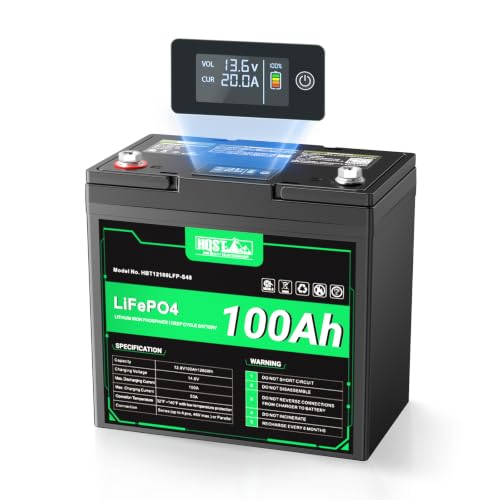
- HQST 12V 100Ah LiFePO4 Battery, Group 22NF Mini, LED Meter leads this shortlist for budget solar builds with a modest array. Use that fit as a reference point, then compare the alternatives against your own space and workload.
- Specs that separate the picks
- The first details to compare are 1,280Wh, 21 lb, 19.13 lb, 5.43 inch wide, Group 24, 100Ah. Confirm the exact model and included components before ordering.
- Trade-off to plan for
- Maximum charge current is not stated
The Practical Shortlist
A road-tested-thinking look at 6 options, organized around the job each one suits best.
Best Budget With Published Limits
HQST 12V 100Ah LiFePO4 Battery, Group 22NF Mini, LED Meter
budget solar builds with a modest array
Our take Check price for HQST 12V 100Ah LiFePO4 Battery, Group 22NF Mini, LED Meter (opens in a new tab)

Best Compact for Solar
LiTime 12V 100Ah Xtra Mini LiFePO4 Battery with Bluetooth
compact bays and vans that want an app
Our take Check price for LiTime 12V 100Ah Xtra Mini LiFePO4 Battery with Bluetooth (opens in a new tab)

Best Group 24 Drop-In
LiTime 12V 100Ah LiFePO4 Battery, Group 24, Bluetooth
Group 24 swaps that want a warranty and an app
Our take Check price for LiTime 12V 100Ah LiFePO4 Battery, Group 24, Bluetooth (opens in a new tab)

Best for Larger Arrays
Power Queen 12V 200Ah PLUS LiFePO4 Battery with 200A BMS
400 watt plus arrays and multi-day off-grid stays
Our take Check price for Power Queen 12V 200Ah PLUS LiFePO4 Battery with 200A BMS (opens in a new tab)

Best AGM for Cold Solar
Renogy 12V 100Ah Deep Cycle AGM Battery
unheated bays where winter solar charging matters
Our take Check price for Renogy 12V 100Ah Deep Cycle AGM Battery (opens in a new tab)

Best AGM With Published Charge Temps
Weize 12V 100Ah Deep Cycle AGM Battery
cold-climate AGM banks that need charge temps in writing
Our take Check price for Weize 12V 100Ah Deep Cycle AGM Battery (opens in a new tab)
Why Each Pick Made the Cut
Best Budget With Published Limits1 of 6
HQST 12V 100Ah LiFePO4 Battery, Group 22NF Mini, LED Meter on Amazon (opens in a new tab)
Choose HQST 12V 100Ah LiFePO4 Battery, Group 22NF Mini, LED Meter for charge cutoffs published at 23°F and 140°F.
Best for
- budget solar builds with a modest array
Why it made the shortlist
HQST 12V 100Ah LiFePO4 Battery, Group 22NF Mini, LED Meter is positioned for budget solar builds with a modest array. The documented setup centers on 1,280Wh, 21 lb, charge stops below 23°F, 100A continuous discharge.
The feature doing most of the work here is charge cutoffs published at 23°F and 140°F. Its 1,280Wh, 21 lb specification sits at between the lower and upper ends of the comparable range in this 3-product comparison. Confirm whether that figure refers to tool weight or working capacity before comparing it directly.
The practical constraint here is maximum charge current is not stated. Confirm whether the stated figure refers to product weight or rated working capacity. Compare it with your lifting, transport and support requirements before deciding.
Key dimensions & specs
- 1,280Wh, 21 lb
- Charge stops below 23°F
- 100A continuous discharge
Pros
- Charge cutoffs published at 23°F and 140°F
- About $125 per nominal kilowatt-hour, lowest lithium here
- LED meter gives a charge check without an app
- 21 pounds, light enough for a van roof
Cons
- Maximum charge current is not stated
- Group 22NF case may not fit an existing tray
Best Compact for Solar2 of 6
LiTime 12V 100Ah Xtra Mini LiFePO4 Battery with Bluetooth on Amazon (opens in a new tab)
LiTime 12V 100Ah Xtra Mini LiFePO4 Battery with Bluetooth makes the shortlist because smallest case here at 9.02 by 5.43 by 8.62 inches.
Best for
- compact bays and vans that want an app
Why it made the shortlist
This model is aimed at compact bays and vans that want an app. The documented setup centers on 19.13 lb, 5.43 inch wide, bluetooth 5.0 app, expands to 20.48kWh.
The most useful documented advantage is smallest case here at 9.02 by 5.43 by 8.62 inches. Its 19.13 lb, 5.43 inch wide specification sits at the lower end of the comparable range in this 3-product comparison. Confirm whether that figure refers to tool weight or working capacity before comparing it directly.
The main limitation to plan around is charging pauses at 32°F, not as tolerant as HQST. Confirm whether the stated figure refers to product weight or rated working capacity. Compare it with your lifting, transport and support requirements before deciding.
Key dimensions & specs
- 19.13 lb, 5.43 inch wide
- Bluetooth 5.0 app
- Expands to 20.48kWh
Pros
- Smallest case here at 9.02 by 5.43 by 8.62 inches
- Bluetooth app shows real-time voltage and charge level
- Expands to 4P4S for a bigger solar bank
- Five-year service support is stated in the listing
Cons
- Charging pauses at 32°F, not as tolerant as HQST
Best Group 24 Drop-In3 of 6
LiTime 12V 100Ah LiFePO4 Battery, Group 24, Bluetooth on Amazon (opens in a new tab)
The strongest case for LiTime 12V 100Ah LiFePO4 Battery, Group 24, Bluetooth is fits Group 24 trays with no refit.
Best for
- Group 24 swaps that want a warranty and an app
Why it made the shortlist
For Group 24 swaps that want a warranty and an app, this is one of the more relevant configurations in the shortlist. The documented setup centers on group 24, 100Ah, bluetooth 5.0, 100A BMS, five-year warranty.
Its case starts with fits Group 24 trays with no refit. Against the other 5 picks, the useful comparison starts with group 24, 100Ah and bluetooth 5.0, 100A BMS. Those details show whether its configuration suits the job better than a neighboring recommendation.
The trade-off worth checking first is exact cold cutoff temperature is not given. Confirm whether the battery and charger are included with the exact package. Check platform compatibility and published runtime against the area or workload you need to cover.
Key dimensions & specs
- Group 24, 100Ah
- Bluetooth 5.0, 100A BMS
- Five-year warranty
Pros
- Fits Group 24 trays with no refit
- Five-year warranty is stated in the listing
- Bluetooth pairs by QR code with the app
Cons
- Exact cold cutoff temperature is not given
- Costs $151 more than HQST for equal energy
Best for Larger Arrays4 of 6
Power Queen 12V 200Ah PLUS LiFePO4 Battery with 200A BMS on Amazon (opens in a new tab)
Power Queen 12V 200Ah PLUS LiFePO4 Battery with 200A BMS is the better fit when 400 watt plus arrays and multi-day off-grid stays.
Best for
- 400 watt plus arrays and multi-day off-grid stays
Why it made the shortlist
The intended use case is 400 watt plus arrays and multi-day off-grid stays. The documented setup centers on 2,560Wh, 200A BMS, about 55 lb, expands to 4S4P.
What separates it on paper is stores 2,560Wh, twice the 100Ah picks. Its About 55 lb specification sits at the upper end of the comparable range in this 3-product comparison. Confirm whether that figure refers to tool weight or working capacity before comparing it directly.
Before committing, account for cold-charging cutoff is not stated in the excerpt. Confirm whether the stated figure refers to product weight or rated working capacity. Compare it with your lifting, transport and support requirements before deciding.
Key dimensions & specs
- 2,560Wh, 200A BMS
- About 55 lb
- Expands to 4S4P
Pros
- Stores 2,560Wh, twice the 100Ah picks
- About $172 per nominal kilowatt-hour for the capacity
- 200A BMS supports a large inverter and big charge input
- Claims 95 percent usable capacity from each cycle
Cons
- Cold-charging cutoff is not stated in the excerpt
- At 55 pounds it takes two hands to place
Best AGM for Cold Solar5 of 6
Renogy 12V 100Ah Deep Cycle AGM Battery on Amazon (opens in a new tab)
Choose Renogy 12V 100Ah Deep Cycle AGM Battery for accepts charge below freezing, unlike LiFePO4.
Best for
- unheated bays where winter solar charging matters
Why it made the shortlist
Renogy 12V 100Ah Deep Cycle AGM Battery is positioned for unheated bays where winter solar charging matters. The documented setup centers on 12V 100Ah AGM, discharge to minus 4°F, self-discharge under 3 percent.
The feature doing most of the work here is accepts charge below freezing, unlike LiFePO4. Against the other 5 picks, the useful comparison starts with 12V 100Ah AGM and discharge to minus 4°F. Those details show whether its configuration suits the job better than a neighboring recommendation.
The practical constraint here is only about 600Wh usable at a 50 percent limit. Confirm whether the battery and charger are included with the exact package. Check platform compatibility and published runtime against the area or workload you need to cover.
Key dimensions & specs
- 12V 100Ah AGM
- Discharge to minus 4°F
- Self-discharge under 3 percent
Pros
- Accepts charge below freezing, unlike LiFePO4
- Series unlimited, parallel up to four batteries
- Self-discharge stays below 3 percent a month
- Sealed AGM design needs no watering
Cons
- Only about 600Wh usable at a 50 percent limit
- Maximum charge current is not in the listing
Best AGM With Published Charge Temps6 of 6
Weize 12V 100Ah Deep Cycle AGM Battery on Amazon (opens in a new tab)
Weize 12V 100Ah Deep Cycle AGM Battery makes the shortlist because charging range 14°F to 122°F is published.
Best for
- cold-climate AGM banks that need charge temps in writing
Why it made the shortlist
This model is aimed at cold-climate AGM banks that need charge temps in writing. The documented setup centers on charges 14°F to 122°F, 12.99 inches long, one-year warranty.
The most useful documented advantage is charging range 14°F to 122°F is published. Against the other 5 picks, the useful comparison starts with charges 14°F to 122°F and 12.99 inches long. Those details show whether its configuration suits the job better than a neighboring recommendation.
The main limitation to plan around is one-year warranty is short for daily solar cycling. Measure the narrowest access point and the available storage footprint before ordering. Confirm what the stated dimension refers to on the exact model and configuration.
Key dimensions & specs
- Charges 14°F to 122°F
- 12.99 inches long
- One-year warranty
Pros
- Charging range 14°F to 122°F is published
- Sealed design needs no regular maintenance work
- Self-discharge stays between 1 and 3 percent monthly
Cons
- One-year warranty is short for daily solar cycling
- Title and bullet disagree on 1150A versus 1100A
How We Built This Shortlist
Each pick was assessed across 5 criteria weighted for real-world use.
- Charge acceptance and voltage
- We read what charge voltage each listing asks for and whether it states a maximum charge current, since an array can only deliver what the battery will accept.
- Cold-weather charging limits
- We compared the temperatures where charging stops and resumes, because a battery that refuses charge on a cold, sunny morning wastes the best panel output of the day.
- Solar sizing arithmetic
- We estimated how many watts of panels a 1,280 or 2,560 watt-hour bank can absorb in a day using a 75 percent loss assumption, and labelled the results as estimates.
- Controller and expansion fit
- We noted lithium-mode requirements for MPPT and PWM controllers and how far each battery expands in series or parallel.
- Weight, size and price
- We compared case dimensions, weight and cost per nominal kilowatt-hour, since roof-mounted solar often shares a space-limited bay.
What Matters Before You Choose an RV Battery for Solar
Key buying criteria so you get the right fit the first time.
Maximum charge current
This is the most amps the battery accepts, and it caps how much of a large array you can use. A 400-watt array can produce up to about 28 amps at 14.4 volts, so a battery limited to 20 amps leaves a quarter of the peak unused. Look for a stated maximum charge current in amps, and if it is missing, ask the seller before sizing panels.
Charge voltage and controller mode
Lithium batteries want a constant-current, constant-voltage profile near 14.4 to 14.6 volts and often no float stage, while AGM batteries use absorption and float. If your solar controller has no lithium mode, it may stop short and leave the battery partly full every day. Set the controller to the battery's stated voltages, and check the controller manual for a user-defined profile.
Cold-charging cutoff
Lithium iron phosphate cells can be damaged by charging below freezing, so batteries pause charging near 32°F. On a sunny winter morning in an unheated bay the panels produce power the battery will not accept. Compare the published cutoffs, such as 23°F for the HQST and 32°F for the LiTime batteries, and decide whether your bay stays warm.
Daily energy versus storage
The right battery matches the energy your panels make in a day, not their rated watts. Panels typically deliver around 75 percent of rated output after losses, so 200 watts at five sun hours yields about 750Wh, which is 59 percent of a 1,280Wh battery. Estimate your array's daily watt-hours and your loads' watt-hours, and size the bank to hold at least a day and a half of use.
Usable capacity by chemistry
Lithium can be cycled to 80 to 100 percent while AGM is usually limited to about 50 percent for longevity. A 100Ah AGM therefore stores roughly 600Wh for your loads, while the same-size lithium stores about 1,024Wh or more. Compare usable watt-hours, and divide price by them for a fair cost per kilowatt-hour.
Expansion and wiring limits
Solar banks tend to grow, and each listing sets how far it can expand. The Power Queen and LiTime batteries allow four in series and four in parallel, while the Renogy AGM allows only four in parallel. Add batteries of the same age and brand, and charge each separately first to balance them.
Match an RV Battery for Solar to Your RV
By Array Size
| Your situation | Recommended pick | Why |
|---|---|---|
| Under 200 watts of panels | HQST 100Ah | A 100Ah bank refills easily and costs $159.99 |
| 200 to 300 watts, compact bay | LiTime Xtra Mini | Smallest case, app, 1,280Wh to refill daily |
| 200 to 300 watts, Group 24 tray | LiTime Group 24 | Drop-in size with a five-year warranty |
| 400 watts or more | Power Queen 200Ah | 2,560Wh absorbs a big array's daily output |
| Any size, unheated bay in winter | Renogy AGM 100Ah | Accepts charge below freezing |
Scroll sideways to see every column.
By Budget
| Budget | Recommended pick |
|---|---|
| Under $170 | HQST 100Ah or Weize AGM 100Ah |
| $170 to $180 | Renogy AGM 100Ah |
| $300 to $320 | LiTime Group 24 or LiTime Xtra Mini |
| Around $440 | Power Queen 200Ah |
Lithium vs AGM for Solar
- Lithium
- Accepts high charge currents and fills faster, so more of a short sunny day is stored, but charging stops near 32°F, or 23°F on the HQST. Covers the HQST 100Ah, both LiTime batteries and the Power Queen 200Ah.
- AGM
- Charges in freezing weather, so winter sun is not wasted, but it delivers only about half its rating. Covers the Renogy AGM 100Ah and the Weize AGM 100Ah.
Most solar RVers should default to lithium unless the battery sits in an unheated bay where it will see sub-freezing sunny mornings.
By Cold-Charging Tolerance
| Lowest temperature you charge at | Recommended pick |
|---|---|
| Regularly below 15°F | Weize AGM 100Ah |
| Around 15°F to 25°F | HQST 100Ah or Renogy AGM 100Ah |
| Freezing mornings only occasionally | LiTime Group 24 |
| Always above 32°F | Power Queen 200Ah or LiTime Xtra Mini |
For Full-Time Boondockers Specifically
- Look for
- Enough storage to carry you through two cloudy days plus a charger profile your controller can match. At a 600W daily load, 2,560Wh covers roughly four hours of use at 80 percent usable, an estimate before inverter losses.
- In this comparison
- The Power Queen 200Ah offers the most storage here, and two LiTime Group 24 batteries in parallel would match its capacity at higher cost.
When to Spend More
- Spend more if
- You want an app or tight packaging: the LiTime Xtra Mini costs $159.60 more than the HQST but is the smallest case, and the Power Queen 200Ah doubles storage for large arrays.
- Save if
- Your array is under 200 watts: the HQST 100Ah or either AGM covers the daily output at $160 to $175.
Before You Bring One Home
How many watts of solar do I need for a 100Ah battery?
As an estimate, 200 watts at five peak sun hours makes about 750Wh after losses, which refills roughly 59 percent of a 1,280Wh lithium battery. For a full refill from 20 percent in one day, plan on 150 to 300 watts depending on your sun hours and loads.
Do I need a special solar controller for lithium?
You need one that can hold a lithium voltage profile, around 14.4 to 14.6 volts per the SUPER EMPOWER and similar listings, with no long float stage. Many controllers have a lithium mode or a user setting. Check the manual before connecting.
Is the Power Queen 200Ah worth the extra cost over a 100Ah?
If your array is 400 watts or more or you stay off-grid for several days, yes, because it stores 2,560Wh and costs about $172 per nominal kWh against about $250 for the Xtra Mini. For a 150 watt roof, a 100Ah is enough.
Can I charge lithium from solar in freezing weather?
Not safely with most batteries; they stop charging near 32°F, or 23°F for the HQST. Options are AGM, a heated battery, or insulating the bay so the battery warms from use.
How do I connect solar to the battery?
Run panels to the controller, then the controller to the battery with a fuse near the positive terminal. Connect the battery first, then the panels, and set the profile for your chemistry before applying sun.
How do I look after an AGM battery on solar?
Keep it from sitting partly charged, because sulfation shortens life. Charge it fully each sunny day, avoid cycling below 50 percent, and check terminals and voltage regularly.
Bottom Line
Best overall: HQST 12V 100Ah LiFePO4 Battery, Group 22NF Mini, LED Meter — best budget with published limits pick in this roundup. See the full verdicts above for every pick, with pros, cons and who each one suits.
Browse all rv batteries for solar on Amazon — Prime-eligible options with current pricing.