
Buying Guide
6 Best 12 Volt RV Batteries in 2026: A Practical RV Guide
Six 12V RV batteries sorted by job and BCI group size, house versus starter, Group 24, 27, 31 and 34, with usable-energy cost math, $150 to $540.
By Hardcastle's RV Editors
10 min read6 products evaluated
A 12 volt RV battery can mean two different things, and buying the wrong one is the most expensive mistake in this category. A house battery runs your lights, water pump and fridge for hours and is built to be discharged deeply. A starting or dual-purpose battery is built to deliver a few hundred amps for seconds and does not like being drained, which is why a high cold cranking amps number on the label says nothing about how long the battery will power your trailer overnight.
We compared six 12V batteries priced from $149.99 to $539.99 and sorted them by job and by BCI group size, Group 24, 27M, 31 and 34M, because the case has to physically fit the tray. For each one we estimated the cost per usable kilowatt-hour, assuming 80 percent usable for lithium and 50 percent for lead-acid, so you can see what each dollar buys beyond the label.
Hardcastle’s RV field notes
The Rig Fit Check
A quick way to connect the shortlist to the space, workload and ownership details that matter after the box arrives.
- Start with the job
- Lithova 12V 100Ah Group 24 LiFePO4 Deep Cycle Battery leads this shortlist for swapping a Group 24 house battery for lithium cheaply. Use that fit as a reference point, then compare the alternatives against your own space and workload.
- Specs that separate the picks
- The first details to compare are Group 24, 12.8V 100Ah, 12V 300Ah, 200A BMS, Group 24, 21.9 lb. Confirm the exact model and included components before ordering.
- Trade-off to plan for
- No Bluetooth readout, so charge level needs a shunt
The Practical Shortlist
A road-tested-thinking look at 6 options, organized around the job each one suits best.

Best Group 24 House Battery
Lithova 12V 100Ah Group 24 LiFePO4 Deep Cycle Battery
swapping a Group 24 house battery for lithium cheaply
Our take Check price for Lithova 12V 100Ah Group 24 LiFePO4 Deep Cycle Battery (opens in a new tab)

Best Large House Bank
VATRER POWER 12V 300Ah Low Temp Cutoff LiFePO4 Lithium Battery, 200A BMS
off-grid trailers with an inverter and big fridge
Our take Check price for VATRER POWER 12V 300Ah Low Temp Cutoff LiFePO4 Lithium Battery, 200A BMS (opens in a new tab)

Best Group 24 With Bluetooth
Litime 12V 100Ah LiFePO4 Battery, Group 24
Group 24 owners who want an app and a known brand
Our take Check price for Litime 12V 100Ah LiFePO4 Battery, Group 24 (opens in a new tab)

Best Dual-Purpose AGM
Mighty Max Battery MM-G27M, 12V 100Ah Group 27M Deep-Cycle Marine AGM
Group 27M trays on a lead-acid-only charger
Our take Check price for Mighty Max Battery MM-G27M, 12V 100Ah Group 27M Deep-Cycle Marine AGM (opens in a new tab)
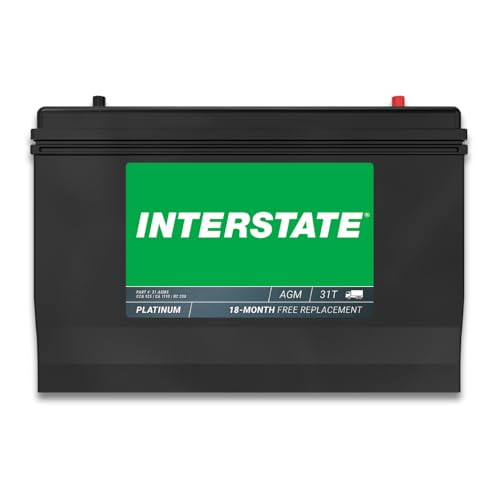
Best Starting and Deep Cycle
Interstate Batteries Marine/RV Battery 12V 100Ah 925CCA Group 31 AGM
Group 31 trays that need both cranking and cycling
Our take Check price for Interstate Batteries Marine/RV Battery 12V 100Ah 925CCA Group 31 AGM (opens in a new tab)

Best Compact Starter
OPTIMA D34M BLUETOP Dual Purpose Boat and RV Sealed AGM Battery
starting duty or a small auxiliary battery
Our take Check price for OPTIMA D34M BLUETOP Dual Purpose Boat and RV Sealed AGM Battery (opens in a new tab)
Why Each Pick Made the Cut
Best Group 24 House Battery1 of 6
Lithova 12V 100Ah Group 24 LiFePO4 Deep Cycle Battery on Amazon (opens in a new tab)
Choose Lithova 12V 100Ah Group 24 LiFePO4 Deep Cycle Battery for fits a standard Group 24 tray with no new box.
Best for
- swapping a Group 24 house battery for lithium cheaply
Why it made the shortlist
Lithova 12V 100Ah Group 24 LiFePO4 Deep Cycle Battery is positioned for swapping a Group 24 house battery for lithium cheaply. The documented setup centers on group 24, 12.8V 100Ah, 1,280Wh, smart BMS, 4,000 plus cycles claimed.
The feature doing most of the work here is fits a standard Group 24 tray with no new box. Its Group 24, 12.8V 100Ah specification sits at the upper end of the comparable range in this 4-product comparison. Treat the battery platform and included charger as part of the fit, not just the headline number.
The practical constraint here is no Bluetooth readout, so charge level needs a shunt. Confirm whether the battery and charger are included with the exact package. Check platform compatibility and published runtime against the area or workload you need to cover.
Key dimensions & specs
- Group 24, 12.8V 100Ah
- 1,280Wh, smart BMS
- 4,000 plus cycles claimed
Pros
- Fits a standard Group 24 tray with no new box
- Claims 4,000 cycles at full and 6,000 at 80 percent depth
- Expands to 20.48kWh with 16 units
Cons
- No Bluetooth readout, so charge level needs a shunt
- Listing excerpt omits cold-charge cutoff and weight
Best Large House Bank2 of 6
VATRER POWER 12V 300Ah Low Temp Cutoff LiFePO4 Lithium Battery, 200A BMS on Amazon (opens in a new tab)
VATRER POWER 12V 300Ah Low Temp Cutoff LiFePO4 Lithium Battery, 200A BMS makes the shortlist because holds 3,840Wh, three times a 100Ah battery.
Best for
- off-grid trailers with an inverter and big fridge
Why it made the shortlist
This model is aimed at off-grid trailers with an inverter and big fridge. The documented setup centers on 12V 300Ah, 200A BMS, 3,840Wh nominal, low-temperature cutoff.
The most useful documented advantage is holds 3,840Wh, three times a 100Ah battery. Its 12V 300Ah, 200A BMS specification sits at the lower end of the comparable range in this 4-product comparison. Treat the battery platform and included charger as part of the fit, not just the headline number.
The main limitation to plan around is does not fit a Group 24 or Group 31 tray. Confirm whether the battery and charger are included with the exact package. Check platform compatibility and published runtime against the area or workload you need to cover.
Key dimensions & specs
- 12V 300Ah, 200A BMS
- 3,840Wh nominal
- Low-temperature cutoff
Pros
- Holds 3,840Wh, three times a 100Ah battery
- 200A BMS supports a mid-size inverter load
- Low-temperature cutoff protects cells in freezing weather
- No acid, so it can be mounted in any position
Cons
- Does not fit a Group 24 or Group 31 tray
- A single battery is one point of failure for the bank
Best Group 24 With Bluetooth3 of 6
Litime 12V 100Ah LiFePO4 Battery, Group 24 on Amazon (opens in a new tab)
The strongest case for Litime 12V 100Ah LiFePO4 Battery, Group 24 is bluetooth app shows charge level and battery status.
Best for
- Group 24 owners who want an app and a known brand
Why it made the shortlist
For Group 24 owners who want an app and a known brand, this is one of the more relevant configurations in the shortlist. The documented setup centers on group 24, 21.9 lb, bluetooth 5.0 app, 100A BMS, 4,000 cycles.
Its case starts with bluetooth app shows charge level and battery status. Against the other 5 picks, the useful comparison starts with group 24, 21.9 lb and bluetooth 5.0 app. Those details show whether its configuration suits the job better than a neighboring recommendation.
The trade-off worth checking first is costs $161.10 more than the Lithova Group 24. Confirm whether the stated figure refers to product weight or rated working capacity. Compare it with your lifting, transport and support requirements before deciding.
Key dimensions & specs
- Group 24, 21.9 lb
- Bluetooth 5.0 app
- 100A BMS, 4,000 cycles
Pros
- Bluetooth app shows charge level and battery status
- Weighs 21.9 pounds, 35 percent smaller than lead-acid
- Stops charging at freezing to protect the cells
- 20 plus protections in the 100A BMS
Cons
- Costs $161.10 more than the Lithova Group 24
- Cold-charge cutoff temperature is not given as a number
Best Dual-Purpose AGM4 of 6
Mighty Max Battery MM-G27M, 12V 100Ah Group 27M Deep-Cycle Marine AGM on Amazon (opens in a new tab)
Mighty Max Battery MM-G27M, 12V 100Ah Group 27M Deep-Cycle Marine AGM is the better fit when group 27M trays on a lead-acid-only charger.
Best for
- Group 27M trays on a lead-acid-only charger
Why it made the shortlist
The intended use case is Group 27M trays on a lead-acid-only charger. The documented setup centers on group 27M, 12V 100Ah, 700 cycles at 50 percent, aGM, sealed.
What separates it on paper is fits the Group 27M tray used in many older rigs. Its Group 27M, 12V 100Ah specification sits at the lower end of the comparable range in this 4-product comparison. Treat the battery platform and included charger as part of the fit, not just the headline number.
Before committing, account for only 80 CCA, weak for starting larger engines. Confirm whether the battery and charger are included with the exact package. Check platform compatibility and published runtime against the area or workload you need to cover.
Key dimensions & specs
- Group 27M, 12V 100Ah
- 700 cycles at 50 percent
- AGM, sealed
Pros
- Fits the Group 27M tray used in many older rigs
- Works on a basic lead-acid converter profile
- 700 cycles at 50 percent depth is stated
- Sealed AGM needs no acid handling
Cons
- Only 80 CCA, weak for starting larger engines
- About $383 per usable kilowatt-hour, double the lithium picks
Best Starting and Deep Cycle5 of 6
Interstate Batteries Marine/RV Battery 12V 100Ah 925CCA Group 31 AGM on Amazon (opens in a new tab)
Choose Interstate Batteries Marine/RV Battery 12V 100Ah 925CCA Group 31 AGM for 925 cranking amps starts large engines.
Best for
- Group 31 trays that need both cranking and cycling
Why it made the shortlist
Interstate Batteries Marine/RV Battery 12V 100Ah 925CCA Group 31 AGM is positioned for Group 31 trays that need both cranking and cycling. The documented setup centers on group 31, 12V 100Ah, 925 CCA, 1,110 CA, aGM, deep-cycle capable.
The feature doing most of the work here is 925 cranking amps starts large engines. Its Group 31, 12V 100Ah specification sits at the lower end of the comparable range in this 4-product comparison. Treat the battery platform and included charger as part of the fit, not just the headline number.
The practical constraint here is about $475 per usable kilowatt-hour for house use. Confirm whether the battery and charger are included with the exact package. Check platform compatibility and published runtime against the area or workload you need to cover.
Key dimensions & specs
- Group 31, 12V 100Ah
- 925 CCA, 1,110 CA
- AGM, deep-cycle capable
Pros
- 925 cranking amps starts large engines
- 100Ah also supports sustained house loads
- Group 31 fits many motorhome and trailer trays
- Sealed AGM cuts maintenance and acid handling
Cons
- About $475 per usable kilowatt-hour for house use
- Costs $135 more than the Lithova lithium
Best Compact Starter6 of 6
OPTIMA D34M BLUETOP Dual Purpose Boat and RV Sealed AGM Battery on Amazon (opens in a new tab)
OPTIMA D34M BLUETOP Dual Purpose Boat and RV Sealed AGM Battery makes the shortlist because compact case: 10.06 by 6.88 by 7.94 inches.
Best for
- starting duty or a small auxiliary battery
Why it made the shortlist
This model is aimed at starting duty or a small auxiliary battery. The documented setup centers on group 34M, 750 CCA, 55Ah, 120 minutes RC, 43.5 lb, compact case.
The most useful documented advantage is compact case: 10.06 by 6.88 by 7.94 inches. Against the other 5 picks, the useful comparison starts with group 34M, 750 CCA and 55Ah, 120 minutes RC. Those details show whether its configuration suits the job better than a neighboring recommendation.
The main limitation to plan around is only 55Ah, about 330Wh usable for house use. Confirm whether the battery and charger are included with the exact package. Check platform compatibility and published runtime against the area or workload you need to cover.
Key dimensions & specs
- Group 34M, 750 CCA
- 55Ah, 120 minutes RC
- 43.5 lb, compact case
Pros
- Compact case: 10.06 by 6.88 by 7.94 inches
- Dual SAE and stud posts suit varied cable ends
- 750 CCA starts most engines in cold weather
- Spiral cells are claimed to resist vibration 15 times better
Cons
- Only 55Ah, about 330Wh usable for house use
- Costs about $1,030 per usable kilowatt-hour
How We Built This Shortlist
Each pick was assessed across 5 criteria weighted for real-world use.
- Job fit: house or starter
- We separated deep-cycle house batteries from dual-purpose and starting designs by reading whether the listing sells hours of discharge or cranking amps.
- BCI group size
- We matched each battery to Group 24, 27M, 31 or 34M and noted stated dimensions, because the case must fit the tray and hold-down.
- Usable energy per dollar
- We computed nominal watt-hours, applied 80 percent usable for lithium and 50 percent for lead-acid, and divided price by usable kilowatt-hours.
- Cold behavior and protection
- We checked for stated low-temperature cutoffs, battery management system current ratings and any warning against specific uses.
- Charger and wiring needs
- We compared the charge profile each chemistry needs, since lithium on an old lead-acid converter charges poorly.
What Matters Before You Choose a 12 Volt RV Battery
Key buying criteria so you get the right fit the first time.
House battery or starting battery
A house battery has thick plates or lithium cells built for sustained, repeated discharge, while a starting battery is built to deliver a short high-current burst and wears quickly if drained. Putting a starting battery on a fridge and pump means it will lose capacity within a season. Look for cold cranking amps on a starting battery, and for cycle counts at a stated depth of discharge on a house battery.
BCI group size
Group sizes define case length, width and height, so a Group 24 is smaller than a Group 31 and the tray, hold-down and cable reach are built for one of them. A lithium battery in a Group 24 case drops into the same tray as a lead-acid Group 24. Measure the tray and compare it with the listing dimensions, and treat a missing dimension as a reason to ask.
Usable energy per dollar
Amp-hours times voltage gives watt-hours, and the share you can draw depends on chemistry: around 80 percent for lithium and 50 percent for AGM. A $230 AGM with 600 usable watt-hours costs more per kilowatt-hour than a $150 lithium battery with 1,024. Divide price by usable kilowatt-hours before comparing, and look for a depth-of-discharge number next to any cycle claim.
Charging profile and converter
Lithium wants about 14.4 to 14.6 volts, AGM wants a similar bulk and absorption voltage, and a converter stuck at 13.6 volts will leave either under-charged. An undercharged battery loses capacity quietly. Read the label on your converter for a lithium or AGM mode, and if there is none, budget for a smart charger.
Cranking amps and what they mean
Cold cranking amps (CCA) is the current a battery can deliver at 0°F for 30 seconds while holding a minimum voltage, so it tells you about starting, not endurance. A 925 CCA battery with 100Ah still has only 600Wh of usable house energy. Match CCA to your engine only for a starter, and ignore it for a house battery.
Low-temperature and safety limits
Lithium iron phosphate cells should not be charged below freezing, so good batteries cut off charging near 32°F, and lead-acid loses capacity in the cold but is not damaged. Some lithium sellers also warn against starting or golf cart use. Read the listing for the cutoff, any warnings and how the BMS limits current, before trusting a battery to a cold bay.
Match a 12 Volt RV Battery to Your RV
By Job and Group Size
| Your situation | Recommended pick | Why |
|---|---|---|
| Group 24 house battery on a budget | Lithova G24 | Group 24 lithium at $149.99 |
| Group 24 house battery with app monitoring | Litime G24 | Bluetooth 5.0 and stated 20 plus protections |
| Group 27M tray, lead-acid charger | Mighty Max G27M | Group 27M AGM with 100Ah |
| Group 31 tray, crank and cycle | Interstate G31 | 925 CCA with 100Ah |
| Large bank in a roomy bay | Vatrer 300Ah | 3,840Wh in one case |
| Group 34M compact starter | Optima D34M | 750 CCA, 43.5 lb |
Scroll sideways to see every column.
By Budget
| Budget | Recommended pick |
|---|---|
| Under $200 | Lithova G24 |
| $225 to $285 | Mighty Max G27M or Interstate G31 |
| $310 to $340 | Litime G24 or Optima D34M |
| Around $540 | Vatrer 300Ah |
House Battery vs Starting Battery
- House (deep-cycle) battery
- Built to supply modest current for hours and be discharged repeatedly. It gives you the most usable watt-hours per dollar. The Lithova, Litime, Vatrer and Mighty Max are in this group, with the Mighty Max also offering some cranking.
- Starting or dual-purpose battery
- Built for short bursts of hundreds of amps, with thinner plates that dislike deep discharge. The Interstate G31 and Optima D34M are in this group, and they suit engine starting more than overnight loads.
Use a deep-cycle or lithium battery for the house bank and a separate starting battery for the engine, unless your rig is too small to carry two.
By Charger Type
| Your charger or converter | Recommended pick | Why |
|---|---|---|
| Older converter, lead-acid profile only | Mighty Max G27M | AGM accepts a lead-acid profile |
| Converter with a lithium mode | Lithova G24 | Cheapest lithium to use it with |
| Smart charger or DC-DC charger plus an app | Litime G24 | Bluetooth shows the charge result |
| Large inverter charger with lithium settings | Vatrer 300Ah | 200A BMS suits an inverter charger |
| Vehicle alternator charges the battery | Interstate G31 | Built for cranking current, not just house loads |
Scroll sideways to see every column.
For a Travel Trailer Replacement Specifically
- Look for
- The BCI group your current battery uses, a stated dimension set, and a charging profile your converter supports. A 12V 100Ah lithium holds 1,280Wh, so two of them (about 2,560Wh) typically cover a day of fridge, pump and lights without shore power.
- In this comparison
- The Lithova G24 or Litime G24 replaces a Group 24 directly, while the Mighty Max G27M fits a Group 27M tray. If your tray is bigger or you want one battery, the Vatrer 300Ah replaces three 100Ah units.
When to Spend More
- Spend more if
- You want an app and a name brand, or need cranking and cycling from one case; the Litime G24 at $311.09 adds Bluetooth, and the Interstate G31 at $284.95 adds 925 CCA.
- Save if
- You only need a house battery and own a shunt; the Lithova G24 at $149.99 delivers the same 1,280Wh as the Litime for $161.10 less.
Before You Bring One Home
What is the difference between a 12V deep-cycle and a starting battery?
A deep-cycle battery supplies steady current for hours and tolerates repeated deep discharge, while a starting battery delivers a short, strong burst to crank an engine and is damaged by deep discharge. For an RV house bank, buy deep-cycle or lithium, not a car-style starter.
Will a Group 24 lithium battery fit where my lead-acid Group 24 was?
Yes, if it is built to the BCI Group 24 dimensions as the Lithova and Litime are. Check the terminal position and hold-down as well, and make sure the cable lengths reach. Lithium is much lighter, so the hold-down may need a spacer.
Is the Vatrer 300Ah better than three 100Ah batteries?
It is simpler, with one battery, one BMS and fewer cables, and costs $539.99 against about $450 for three Lithova units. But three small batteries can be replaced one at a time and fit smaller trays, so the choice depends on space and risk tolerance.
How do I wire a 12V battery safely?
Disconnect all loads, connect the positive cable first and the negative last, use properly sized cable and place a fuse close to the positive terminal. Torque terminals to the maker's figure and verify voltage with a meter before reconnecting loads.
Can I mix a lithium battery with my existing lead-acid one?
It is not recommended. They have different charge voltages and internal resistances, so the bank will charge unevenly. Replace the whole bank with one chemistry, or use a DC-DC charger and an isolator to keep them separate.
How should I store a 12V RV battery in winter?
Store lithium at roughly half to 80 percent charge, disconnected, and keep it above its low-temperature charge limit when possible. Store lead-acid and AGM fully charged and top them up every couple of months to prevent sulfation.
Bottom Line
Best overall: Lithova 12V 100Ah Group 24 LiFePO4 Deep Cycle Battery — best group 24 house battery pick in this roundup. See the full verdicts above for every pick, with pros, cons and who each one suits.
Browse all 12 volt rv batteries on Amazon — Prime-eligible options with current pricing.